Wednesday, January 25, 2006

Dakar by Bus


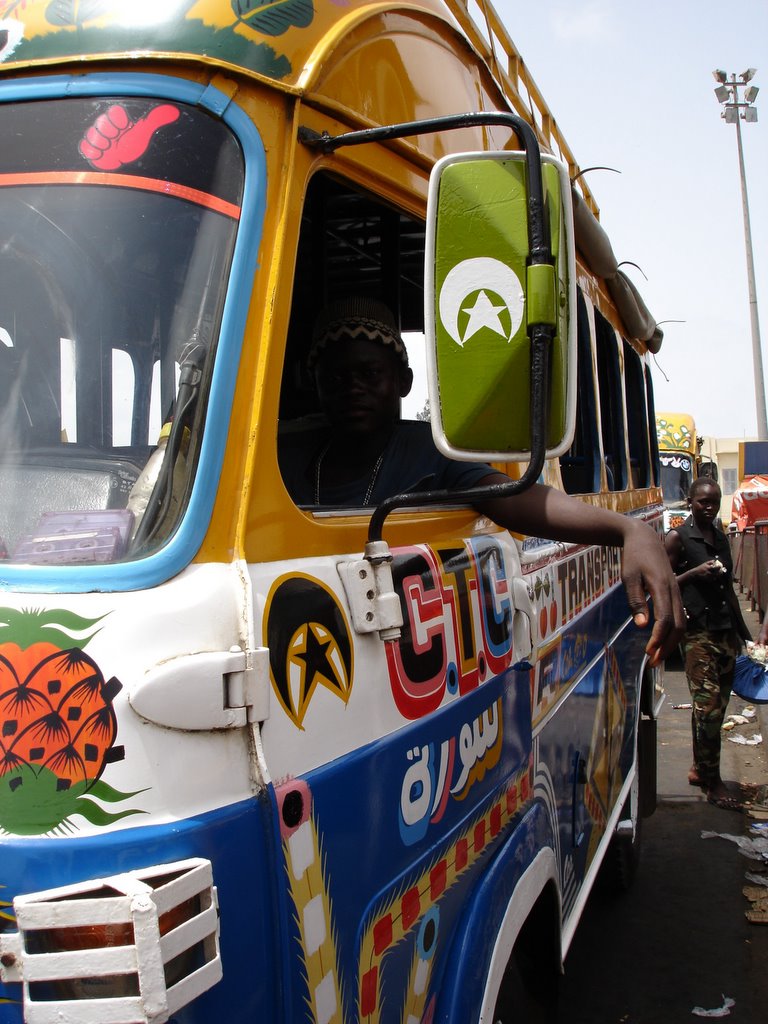
Taking Dakar’s buses, the diagen-djiaye, is an art. They hurtle up and down the Route de Oukham, from town at one end and past the turning to my house at the other. They are run by groups; a driver and two ‘apprentis’, dusty-faced boys who hang off the back shouting their destination “dakadakadakadaka” for town and “wakawakawakawaka” for my end of the route. These boys can look around ten years old and be as mean as anything.

The buses are in bad shape and you can always hear them coming. Their rattling tin structures are held together by people, five to a row, ten rows, two passengers in the front with the driver. The only exits are at the back and at the front, and no alley for passing through the bus. So if you get in, you have to make quite sure that you don’t want to get out very quickly. They do not let you stand and if one person climbs out, everybody has to up and advance “advanadvanadvan” through the bus until the seats are filled again, with more entering the back until the whole bus is full, “fesnafesnafesna”.

When you want to get off, you stand and tap a coin noisily on the roof and shout “maima”, ‘let me off’, until the driver slows down. Sometimes he doesn’t want to stop and then old men and fat women start shouting “maiko”, 'let her down', in a crescendo, sometimes in chorus, sometimes in harmony, until he is forced to pull over. You must always grumble when getting out, either about the time it took for the driver to stop or about the change the apprentis gave you, as the fares are fixed but no one knows what they are and they differ from bus to bus.

The floor of the bus has holes in it to give you the Chessington World of Adventures feeling. There is nothing more fun than to watch pot holes disappear at speed underneath you.

The front of the bus is plastered, usually seeping half way down the windscreen, in photos of religious idols and pop idols. Cheikh Ibra Fall stands in austere dress next to Viviane N’Dour in threads of lycra. He is bony because he lived a life of hard work in devotion to his spiritual guide. She is bony because otherwise she wouldn’t fit into her dress.

At night time the buses are packed more than usual with people going home from work and a bare light bulb lights the inside, swinging to and fro and knocking people’s heads when they stand up.

A fat lady climbs in next to me. She is wearing a pale blue bouboub widely cut across her shoulders so that her bra straps are showing, her shoulders and much of her back. I can almost feel the cushion of her skin and she smells of perfumed water. With her bra straps she is saying ‘I have nursed ten children and will nurse their children too’. She all but smothers me in her folds of flesh and, perching on the middle tip-up seat which accommodates only the smallest of bottoms, I squash up next to my neighbour on the other side and apologise for all but smothering him. He doesn’t seem to mind.

The apprentis starts shouting “passpasspasspass” for us to pass back our fares. Each coin travels ten rows, from hand to hand, the apprentis prodding the fat lady with a dirty finger, and her fleshy fingers poking the bony man infront, and he tapping the girl in a headscarf infront of him and she pointing to the boy two rows infront of her until the passenger has been identitfied, says where he is going, argues with the apprentis about the price, then reluctantly passes back a coin, from hand to podgy hand until it reaches the apprentis who roots around in his pencil case, finds the right change, prods the fat woman and gives her the coin which moves deftly along the rows until it reaches its rightful owner. With one passenger taken care of, so the next must be attended to.

“This is gymnastiques,” says my neighbour, a young man coming home from college. My stop comes and I bang on the roof. The fat woman shouts “mai-ko” and the driver slows down. She starts grumbling and I have to climb over her because she refuses to move. I cut my leg on a shard of metal sticking out from one of the seats.

Just as I start to climb down the wooden boards at the back of the bus, the driver moves off. "Mai-ko" they all shout and the apprentis rings a bell loudly. I grab hold of the ladder which is partly attached to the back and swing down onto the road, which has started moving. The bus behind advances towards me and I am engulfed in fumes from my own bus. This is all part of the diagen-djiaye experience.

Friday, January 13, 2006

Oncl' Sam's


Today is the big festival of the mutton in Senegal and everything is shut. Shops, internet, transport. Everybody is at home slaughtering a sheep and letting its blood run into the earth, to keep the family well for the year ahead. They tell me that my neighbours will come to give me some meat later- at least, this is what happens in the countryside. But my street is new to me and even though the thought of mutton doesn't excite me much, because all the shops are shut I only have crispbread and peanut butter to eat so rather hope it does happen.

My flat is lovely to wake up in. My bedroom faces onto the end of the airfield (and this baobab tree, see photo) where planes don’t come and all I can hear in the mornings is birds perched on the distant baobab trees. Sometimes one comes knocking on my window.

After six months of living either in a compound with lots of people, or in other people’s houses as a kind of guest that never leaves, to live alone is a treat. I listen to the World Service almost all the time, catching those programmes you always seem to miss when there is going out to work to be done, or other people around. I work when I like, sometimes until two am and then go to the beach in the day. I eat chocolate for dinner, if I feel like it, and if I want to I can do quite a good job of forgetting I am in Africa. I think I will last much longer here if I have my own hideaway because in the end, we all hanker after the familiar, after crispbread and peanut butter instead of mutton intestines. But it doesn’t mean I love Africa any less.

Last night I finished work at midnight and I felt like dancing. I called my friend Gabi, a computer engineer and asked if he felt like going out. Taxi prices have shot up because everyone is saving for their sheep and I had long discussions with taxi men as to why I should have to pay more just because they have three wives and twenty children to feed. Gabi lives in a neighbourhood with a lot of Congolese and Ivorian people and there is a place there called ‘Oncl’ Sam’s’, a kind of warehouse filled with plastic furniture, florescent strip lights and hundreds of people grouped around tables groaning under the weight of empty beer bottles.

Gabi and I sat a table with some of his friends and I counted forty-five empty beer bottles on our table before my eyes blurred. There were girls twitching and grinding their bottoms to Congolese songs pumping out of a booth in the corner and men wearing sunglasses slumped low in their chairs, looking like they were going to fall asleep. Every now and then, they would leap up and dance in a row, all watching themselves in the huge mirrors that lined every inch of wall space, doing the most extraordinary dance moves, to great applause from their friends.

One girl in particular caught everyone's attention. She wore a very small pair of jeans and a g-string with a silver bow joining the threads together. She was a hit with the boys. The silver bow flashed and glinted under the harsh lights so that no one could take their eyes off it. Her perfectly round bottom became the focus point of the evening. Everyone was so beautifully turned out and I, as ever, felt like a refugee even though I was wearing a dress. I felt so white under those lights, and so old looking on at the scene of debauchery with wide-eyed shock. I had fun but I hope I never have to go there again, or if I do, I will make sure I wear much less clothing and drink a lot more beer.

I have a neighbour in Dakar who is a bit more up my street. She’s from Birmingham and lives alone, too. We said we would go out and listen to music together. It’s good to have friends.

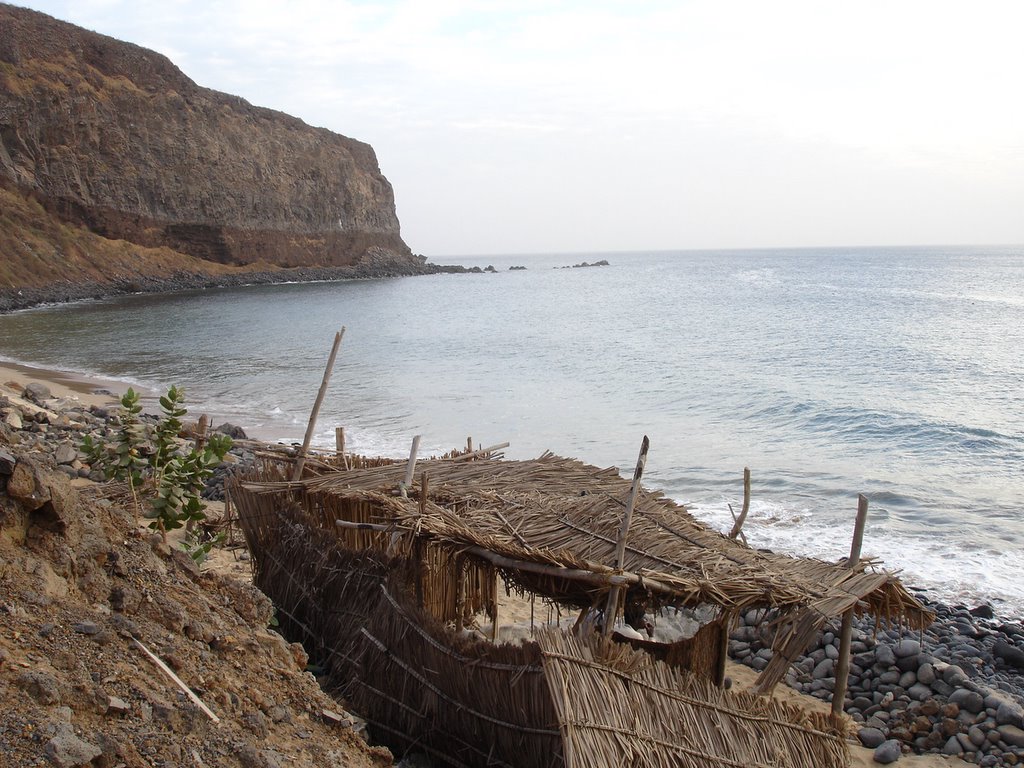
Every afternoon this week, after I finish work, I have been going to the beach below the cliffs opposite my house. A lighthouse looms above it on the cliffs and the sea is calm, protected by the bay. I take Jane Austen and wield it at the boys like a sword and hope they will leave me alone. In this cold weather the sea is quite soft and peaceful and sometimes it rubs off on me.

Sunday, December 25, 2005

Sahara


It's been quite a month. I was back in Senegal a week before I had the chance to leave again, this time by foot, across the Sahara.

At Rosso, Senegal, I was set upon by bandits who took money to send me across the Senegal River, and the border with Mauritania, to an illegal landing point where I climbed through a whole in a wall to enter Mauritania without a stamp in my passport. Then I had to go back to the border the next morning and explain that I had made a mistake, and would they put a little stamp on that page. They did, for a fee.

In Mauritania, there is only one thing to do. There is a train (see photo), the longest train in the world. It runs from Schoum, a selection of huts in the Sahara, to Nouadibou, a town on the coast and border with Western Sahara. This train is 2.5km long, 200 open wagons, and carries iron ore to the port for export.

I reached Schoum under the guidance of a man in a blue butcher's coat, a hulk of a man with a mass of facial hair. He carried a baby goat in his arms, cradling it as if it wasn't going to be eaten later. He and I took a 4x4 to Schoum across desert of blinding beauty, we stopped for prayer at sunset, to pick up a man living with his family in a tent, to drink some camel milk.

The desert is not empty, as I imagined. It is full of low bushes and camels and hillocks and hills and rocky outcrops and families living in one place before moving to the next. It is cold and windy when the sun lowers, and to fall asleep in the car and to awake looking out of the window at such a lonely and confrontational landscape, as if in its infinite size it has the power to swallow small people up, is humbling. Frightening.

At Schoum, the butcher, the goat, and I stood in the darkness straddling a narrow set of train tracks. We looked both ways and saw no lights. Perhaps the train had already left. We asked some kids, they said the train was late. I went to a gas-lit hut and asked for some couscous, which they brought, with a camel bone in the middle, shards of meat and sprinklings of sand. The friend of the couscous server took me in another 4x4 to the train tracks and we saw a light in the distance, the front of the train, and one kilometers behind it, the rear. It rattled past and eventually stopped. I climbed a ladder into a wagon full of fine iron ore and the man waved me off.

I stayed 18 hours on the wagon, my head wrapped in a cloth to keep out the black powder and the cold. It was a full moon and under it I travelled 700 kilometers across the Sahara, past dunes and camels standing lonely on a hill, past villages built from oil drums, nomad dwellings, through the night and into a cold and misty morning.

At Nouadibou, the taxi driver would not let me sit in the front of the car. This is not a woman's world.

I shared the taxi with a man who looked like a Rajasthani Indian, fine black circles ringing his eyes and a long slender face. The driver was as dark and round-faced as a Senegalese. A woman got in as pale as me, dark brown eyes. They all spoke Arabic. No two Mauritanians look like they come from the same place and both men and women are as striking as any people I know. The men wear billowing pale blue cloths, the women metres of pinks and yellows and reds.

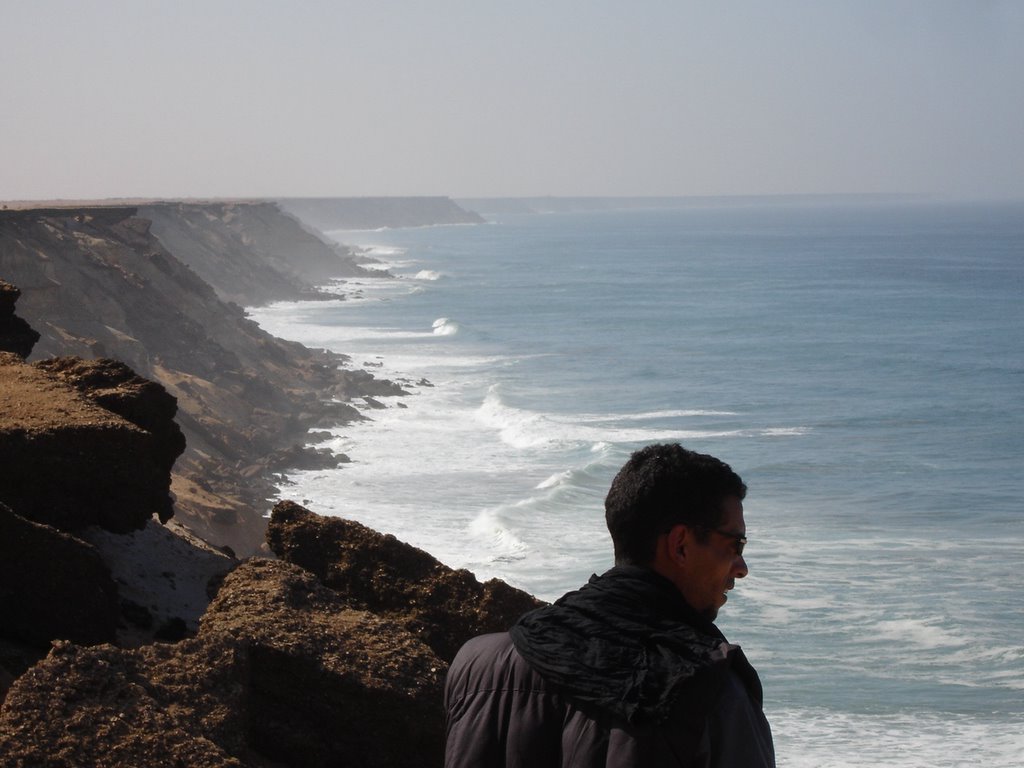
In Western Sahara, I hitch-hiked on a sardine truck, flip-flop vans and in a Mercedes Benz. The driver of the sardine truck, pictured here on the coast of this vast country, played independence-for-Western Sahara-music (suprisingly cheery stuff) for 600km and refused to take any money at the end of the trip. In the flip-flop van I was accompanied by two Mauritanians who sat in the back with the plastic shoes and brewed tea on a gas canister. When it was ready they drummed on the side of the van and we stopped and climbed out into the night, the sand beneath my feet cold like snow, and drank tea in the darkness. The driver was pleased to give me, a woman, a job (handing round the tea). So there is a role for women in this country, after all.

In Rabat, Morocco, I went to the steam baths. After a hot scrub I sat in the changing room and talked to other women. It was the first time I had spoken to a woman, spoken openly to anyone, since leaving Senegal. They asked me what cause I defended as a journalist and I felt this was a country and a people I could love, a people engaged in politics and world events. I told them women in Mauritania can not sit in the front of cars and they were horrified. Here, they said, we are free.

I ate well in Morocco. Fresh vegetables, good bread, stuffed sardines, mint tea, grilled meat, spices and dates and sweet nutty treats. I saw thousand year old arches hiding clusters of blue and white houses, Andalucian gardens filled with clementine trees. Men bringing in olives from the fields, saddle bags straddling donkeys, barefooted children herding goats. Goats climbing trees. Stylish and sophisticated cities, uncluttered, clean. Not one person tried to sell me a carpet. And I wanted to buy one.

In London no one believed I saw goats climbing trees.

Monday, November 28, 2005

Coming Home


On Saturday night Ado and Aliou, friends from the neighbourhood, came to dinner. In the morning I went to my local market, a shed full of ladies at tables, each selling:

Three or four floppy carrots
Quarters of cabbage
MSG ‘stock’ cubes
Handful of dried fish pieces
Unknown green leaf with holes in it
Small sachets of pepper and chilli
Single cloves of garlic
Perfectly round white onions
One aubergine

I have a friend, Kris, who sells fish. Kris is very fat and quite beautiful, loud as you might imagine a fish seller, prone to cackling and trying to sell me off to the meat seller. She sold me some mackerel so I went home with a basket of fish and floppy carrots. With this and some spices I managed to secrete into my luggage from Brixton Wholefoods, I made a good hot curry, which went well with the salted and grilled fish (done by my kitchen aid, Mariam Tounkara) and a bowl of white rice, steamed by Tapha’s sister Rama.

Curry was good but I wished for double cream.

I made all of this with a small child on my back, Kati, who insisted on tasting everything that went into my mouth so that I dropped hot sauce on my shoulder as she tried to get it into her mouth.

Ado and Aliou came to eat, we sat on the mat outside the house, and I wished I’d made Senegalese food. Senegalese people don’t like to be surprised by food and I think the vegetable curry was a bit too much for them to bear. They left the bowl very early on in the proceedings. I was left with the children, who came to suck the fish heads, and we put in another twenty minute’s good work at the bowl before I felt so full I had to go and lie down.

At midnight I donned my new dress and went on the back of my motorbike to le Tamarinier, a bar in town. Tapha’s band were playing there, so I danced with Kris the fish seller and her enormously fat sister and brother until 4am. Kris is trying to win back her ex-boyfriend, zacharia, who plays in the band, so she made elaborate displays of affection during the concert, like rolling up very close to him and dancing, seductively placing bits of fresh coconut in his mouth while he strummed his guitar faster and faster. I’m not sure his motorbike will cope with them getting back together. It was always broken when he used to have to ferry her around town on it.

On Sunday morning, I was invited to lunch by Pap Toutti, the bassist in the band. We all met at Samuel’s house, a French engineer who is working in Ziguinchor on the new port. I went to discuss the band, which has run into recording problems because the man employed to record the album has given up working on it since he received the money. We decided that the band had to get its own speakers, since half the money they earn from concerts goes to hire the equipment. Samuel suggested a concert for his company working at the port, and instead of being paid the cash, Samuel will buy them the speakers with the money.

At three oclock, we decided to have a rehearsal that evening. I called Tapha, who organised going to le Tamarinier to pick up the instruments left there the night before and to hire the speakers for the evening. I sent Pap Tutti off on his bike to find Zacharia, who lives on the other side of town. I sent Matar, Tapha’s brother, on my bike to fetch Maho, the guitarist, and eventually all arrived except Maho, who was playing in another concert at the church. The rehearsal started less than an hour late, a miracle in precision timing, something that doesn’t come naturally to Ziguinchorois.

I was in charge of the children, who all poured in from the neighbourhood and battled for front row seats in the courtyard. There were a lot of tears as boys smacked girls and girls pushed boys off chairs. With Kati tied on my back I did the washing as the music played and made falafel for dinner. I sent Coyo, my kitchen aid, to the market to buy salad and bread, and then went off in search of mayonnaise.

I found a woman who sells mayonnaise by the spoon. One spoon = 50 francs, 5 pence. She was sitting outside her shop roasting peanuts. She only wanted to sell me the stuff if I brought her the bread to spread it on. I told her I wanted it in a little plastic sachet and would even pay her 50francs for the sachet. She couldn’t bring herself to do this; apparently it upset her delicate sense of order and balance to do something a bit out of the ordinary.

There was a lot of discussion. She continued roasting peanuts and Kati, now by my side and holding my hand, started chanting for peanuts. Eventually the woman squeezed herself through a narrow gap in the shop front and went backstage to put my mayonnaise in a bag. I started asking myself how long that pot had been sitting there open, unrefrigerated and what I might possibly catch from it. I decided salmonella was my best bet. She took a long time to measure out my two spoons of mayonnaise and when she came up for air, she was bent on the ground, I said it wasn’t enough. She said that two spoons of mayonnaise in a bag was smaller in quantity than two spoons of mayonnaise on bread.

Discouraged, I took my bag of warm salmonella back to the house where the band were really getting going and a group of women had gathered by the compound door and were dancing wildly. Someone came along to play the tama drum, a small drum that goes under the arm and changes pitch as it’s squeezed. I was set upon by the little girls who all wanted me to carry them so I danced instead. Tapha’s father came along to watch, very small these days, leaning on the front door frame.

This band, if they get themselves organised, will be the most popular band in Senegal one day. iIt's soulful, full of funk, one family of brothers making good sounds.

With rehearsal over, I set about frying the falafel. Falafel, I decided in England, was my best chance of eating enjoyable nutritious food. When I found chick peas in town, it was like all my christmases had come at once.

But the gas I cook on, a bottle with a small gas ring screwed into it, burns the food on one side and doesn’t get hot on the other. Also, the oil I used (Senegalese oil; I am trying to support local enterprise) somehow dissolved my falafel into a kind of chick pea and oil soup. It had to be thrown away.

It was only the first time I have cried from frustration since coming home so things are going quite well. I had rice and fish for dinner.

Tuesday, November 01, 2005

Fridges and donkeys


Well, this is my first ever blog. I hope I'm doing it right.

I started doing this a few months ago when I moved to Senegal but then I never had the right surroundings to actually post anything on it. Now I am back in London for a few weeks recovering and I happened to meet a friend, Barbara, who runs a world music festival in Sweden (www.selam.se) who said when I told her the story about the donkey that if I got my blog going, she'd link it to her website.

So this is for you Barbara.

I'm Rose. I live in a damp shed in Ziguinchor, in the south of Senegal. I built it in 5 days, not with my own bare hands, but Asso, the mason, built it out of concrete (although I wanted mud). I have lived in it for five hot rainy months, and it's never dried out. I have a foam mattress (mouldy), and now a sofa which looks uncomfy but is in fact quite good. I brought the fabric from Guinea Bissau when I went to cover the elections (I'm a journalist).

The house is in a compound of a family. There are 20-something people in this family, maybe more, I'm not sure. Also in the compund is a recording studio with a soundproof booth made from mud and a car windscreen for the window. I'll talk about the studio on another day. I have lots of adopted children, all under 7 years old. They help me cook and come into my house and put sand everywhere. During mango season I made mango jam and it was a disaster. That was back in the early days when I still had energy, before summer came.

So I live in this house, I write articles about music and economy and security situations and I try to live and cool and relaxed African life. It's sometimes not so easy.

Should I explain about the donkey?

After three months or so of living in my damp shed, I decided to buy a fridge. There was a whisper on the streets that someone was selling one on the other side of town, for £50. I went over on my motorbike and had a look. You know those fridges you see abandoned on the street in Brixton that you might put rubber gloves on to touch? i think there's a thing going on where people collect those fridges and send them to Africa. I'm sure it's an African who's doing it. This fridge has cockroaches living in the plastic door seal. I say 'has', I paid the cash and took it home.

People transport things in Ziguinchor by donkey. Salet mbam (wolof for 'donkey cart') are everywhere, a guy with a whip sitting on the cart, transporting things around town. We called a salet mbam from the road, argued over the price for taking the fridge home, then sent him on his way while I made my way slowly back via motorbike.

Now this fridge is in my damp shed. We have an electric cable that runs from the main house in the compound through their bathroom window, through mine, through the bedroom and into the living room. I hang my washing on the cable. It has a rusty fan that dangles off a wire at the back and when the electricity cuts twice a day (or when one of the kids sticks his fingers into the chinese adapter and cuts off the supply) it sighs to a halt and then bursts back to life in the middle of the night, the noise reverberating through the house and waking me up. By that time icy water has melted all over the floor (but never drowning the cockroaches) and the wet floor mats have started to rot.

BUT! We do have cold food and I got to drive a donkey.

This is a photo of me eating mangoes in the compound. And drinking Swiss Miss Hot Chocolate imported from America by my sister, as were the martini glasses and swizzel sticks. There'll be more postings once I'm back in Senegal, and maybe I'll tell the story of how I got fridge number 2 home (never underestimate the efficiency of child labour).

pip pip, Rose