Thursday, August 31, 2006

The Dakar-Goree Challenge: Day 12

This morning I awoke to hear the most glorious of sounds: rain. What's more, I was cold. I thought, I've been magically transported to England, and as I lay curled up in bed listening to the thunder and rain, I thought, that was the first night I have slept the whole night through without getting up to get water, chase a mosquito out of my net, have a cold shower or check to see whether the electricity had come back on and I could charge my computer. What's more, it stayed 'cold' (ie: I could wear a vest, singlet, tank-top without pouring with sweat) until about now, 9pm, when I am back to sweating again.

Remember the sea urchin spine?

Yesterday, while i was out in the street learning Wolof with Now (we had no electricity yesterday either and once my battery was flat, there was no more working unless it was in pencil), my right arm started to hurt. The skin felt sore to touch and my fingers ached. A weird sensation. I went to town to buy a swim suit and a swimming hat. That was an experience. As I flicked through a rack of 12 tiny swim suits at the country's biggest sports shop I began to despair that I would ever find one my size, but then Omar popped his head around the rack and I knew all would be OK. Omar is the only man in the country who knows about customer care, he's the only man in the shop who says things like, "you need that in a 42? let me look'. The others say things like, "you need that in a 42? let me look" and then they disappear off to lunch.

Omar and I sorted through a lot of swimming costumes, all size 36, until we found one in my size, and since it was the only one in the shop (and therefore the country), I didn't have the luxury to stop and consider whether or not it looked good. Once we had the suit, it was time to chose the hat. Omar was concerned that the cap matched the swim suit so after trying on a lot of hats, and doing a lot of giggling, we chose the silver one. It can only make me go faster.

After that I went to meet naomi. I was sitting on a harmless-looking metal electric box thing outside this shop, and I leant my elbow on the metal grate on the window and suddenly I was flying off my seat- I had been electrocuted, but not enough to kill me, just cause me sever pain.

Well, I got over that and managed to go to a good reggae concert with a friend who's just come over from London (with 2 pounds of cheese and a loaf of organic poppy seed bread as a gift) but at about 2am I started to get a headache and I realised that the weird tingling and sore skin had spread around my head and infact all down the right side of my body. Probably cerebral malaria, I thought, and had another glass of wine. Or maybe, said Catherine, you've got sea urchin spine poisoning. Now there's something I hadn't though of, and it's true that bits of the spine were still at that point in my foot. When my head started to pound I went home.

This morning I awoke with a weird rash on my neck.

"I'm worried about you," said Naomi. Well, you know, you're probably always OK but here, people die of stuff a lot and so it's easy for a headache to become in your mind a deadly cocktail of TB-Cholera-Typhoid. Luckily we had no electricity so I could only work until my battery ran out, and since it was cold I stayed in my pyjamas all day and hung out with Now at his shop where I got loads of sympathy for being on death's door. In the afternoon, my illnesses cleared up and I dug out the remainder of the sea urchin spine and I was OK.

But of a crap ending to the story I know.

But here's something that'll crack you up. I hope to God that no one important reads this, like the editor of the Sunday Times, who was reading this very blog only last week.


We had had no power for eight hours today, and we were starting to get bored. So I decided to try on my swim suit. And then the hat and goggles followed and before I knew it I was posing for the camera. I feel I have already lost a lot of respect out there for posting the picture of me in a red swimming cap so it can't get any worse. Actually, it was Karen who goaded me into putting up there, but then, she hadn't seen it at that point. Maybe she'll think differently about it now.

Anyway, all of this is to tell you that I didn't swim today because of the cerebral malaria and yesterday because I was buying the Very Serious Swim Suit and getting electrocuted but my brother and his girlfriend Mati have now said they'll give me £50 if I do the swim and £100 if I finish it which means if I don't start some serious training very soon then I'm going to deprive the kids of £50.

Tuesday, August 29, 2006

The Dakar-Goree Challenge: Day 10

One of my latest articles has been on a koranic school in Dakar and the work that a friend of mine, Pape, has been doing with the children there.


The boy in the photo was sent from his home in Casamance at the age of 5 to Dakar to study the Koran at a kind of religious boarding school. Such is the culture of religious schools in Dakar ( as opposed to their village versions where the children are generally treated much better), many of the kids are sent out to beg for their food and are very often beaten for not bringing in enough money. They are usually malnourished, abused, and never get a modern education (although that being said, there are some schools where the children get a good education and are well treated).

My friend Pape, a poet, film writer and ex-NGO worker, has been working with a school in his neighbourhood of Dakar for 2 years. He has managed to build up a good relationship with the teacher and change the way things are done in the school, so much so that the teacher has now set up his own association where he and 6 other school teachers try to find alternative sources of income and educate other people about the rights of children. The children in this school no longer beg, nor are they beaten, and they now do extra curricular subjects such as French and photography as well as play football with children from the neighbourhood, which is not allowed at other schools.

One of Pape's projects is buying chairs and tents for the school, which are then rented out for ceremonies, providing a regular income for the school. This money gets the children hot food, clothes, medicine, and means they are no longer forced into the streets to beg.


I have spent a few days at the school and they are really lovely happy boys, despite the terrible conditions they live in. And I would really like to help them buy more chairs and clean up the place where they sleep, which is one tiny dirty room in a derelict house where 15 of them sleep on a mat on the bare floor.

This is where my swimming challenge comes in.

You all know that I'm doing the swimming challenge right, and now that I've done the Ngor Island swim I think I might be able to do the Goree Island swim, which is 3 times as far. I've decided to raise money for Pape's school by asking people for sponsorship.

The money will go to Pape to be spent either on chairs to rent out or on cleaning up the room where they live, perhaps buying mats, basic medicine etc. I would also like some of the money to go to Pape, who in 2 years has never received a penny for his work, despite being presently out of paid employment (although he has just had his film script accepted in Paris).

Since sending out an email to friends about this, I have raised £200, which can buy a lot of things for the kids. If this generosity keeps up, I'm going to split the money between the school and another informal project which Pape has going with some friends of his from the States, who regularly donate money. When a 13 year old girl came to his house in Dakar asking for work, he asked her why she wasn't at school. She said she had left her village to find work and no longer went to school. Pape has now found enough money to support her and another young girl through school and university.

If I raise enough money I will give this money towards supporting another young girl through her education.

If you would like to sponsor me, please email me and let me know how much you'd like to give. I will have a PayPal account set up or if you have a British bank account you can do a direct deposit or send a cheque to my address in London.

In other (swimming) news, the pool was shut yesterday so I decided to go body boarding instead. I have new flippers and thought it would be a good idea to test them out on the wild piece of coast near my house. I cycled off with my board strapped to the back of my bike and arrived an hour before sunset, beautiful clear water and only two surfers in it.

"There are sea urchins everywhere" says this guy who has to come down to the beach to tell me how to get into the water (the rocks and pounding waves evidently confusing me).

Well, I'm not going to tread on one, say I to myself, and plunge into the rocky frothy water and paddle off into the sunset (literally).

"Why aren't you taking any of the waves?" says this not unattractive surfer guy, as I bob up and down pretending I'm just happy hanging out without taking any of the waves. I don't tell him it's because the waves are 10 feet high and I'm terrified that one of them will take me on my board and dump me on the sea urchiny rocks.

"What, you've never done this before?" he asks, "Be careful" he adds, and looks at his friend with raised eyebrows.

Well, it was fun (I have done it before a few times, just not right there, with the rocks and the huge breakers and the spiny sea creatures) and relaxing, and a nice thing to do after a day in an office.

But getting out was a whole other deal. Feeling the eyes of the surfers on me as I start for the first time in my life praying, and paddling really really quickly, I reach the rocky shore just in time to get my flippers off before a wave comes and, crunch, put my foot down on something really quite sharp. But since my whole body was hurting, a hurt foot didn't seem like too big a deal and after having a conversation with another surfer about how my board is designed for a small child (he held up an adult one to show me how inadequaltely equipped I am- "I don't know who's going to fix your back if this board snaps mid wave"), I peddled off home.

Arriving home, (there's not much more, I promise), I find the power is cut. And it stays cut until 4pm this afternoon. So with my computer battery dead, I spend much of the day swatting flies (oh, and swimming 1km at lunch time), and only see the black poisonous-looking spine in my foot in the morning, when I also see that I can't walk. Poor Naomi is given a needle to dig it out.

Sunday, August 27, 2006

The Dakar-Goree Challenge: Day 8

Only three weeks left until the big swim.


Yesterday I endured a highly stressful day reviewing Dakar's beautiful Meridien President hotel at Almadies, Africa's most westerly point. To make sure my readers are given up to date information on where to stay in Dakar, I spent many hours testing the water quality of the pool, scrutinising the views from various parts of the gorgeous beach-side complex including from the jacuzzi, and seeing if the towels were as fluffy as they should be. I can report that all seemed to be up to a good standard. So my swiming yesterday involved about 7 lengths of the 25 metre pool, not really a 'training' day then, but so enjoyable, clean, peaceful and no pumping Senegalese pop music, which is what we get at the public pool and which makes the experience of swimming 1.5km even more stressful.

Today was the End-of-Week-One sea swim. I'm not scared of under tows, rips, currents, drowning or sharks, but I am afraid of sea weed touching my toes or of a small fish nibbling at my elbow. I also don't like swimming when the water is full of goat hair. Ngor beach is Dakar's Blackpool Beach, except there's a densely populated fishing village at one end of the bay and there they believe that the beach is for livestock and dumping rubbish, because, well, that's where they've always done it. The fact that the bay has now become a big hang-out for tourists and locals doesn't meant that villagers have stopped giving their goats baths in the water.

After staying out until 4 this morning listening to a great Senegalese-French jazz band (called Moussa Diouf), Cecilia, Alistair, Naomi and I convened at Ngor beach for our first sea swim. Alistair had been out drinking until 5, apparently, and has also done no training for it, but his enthusiasm overcame both of those small obstacles and we were very happy to have him with us. Cecilia is my swimming buddy and she was also wearing a swimming hat so that I didn't feel like the only idiot on the beach. Naomi was charged with carrying the bags across on the pirogue (which ran out of petrol half-way across so that we almost beat her across).


And so we set off, after much discussion about the best place to cross, eventually choosing the village end of the beach, and the goat-washing end. I kept my mouth well closed until we were out half way across and the water became clear and lovely.


After being afraid of the fish and the 700 metre swim, it really wasn't a big deal and only took 18 minutes. On the other side we had lunch in a lovely breezy cafe and decided to swim back as well. My gorgeous red bonnet split before I'd launched off on the return leg (even though it was only the third time I've used it), so I am now without-hat but tomorrow I'm off down to City Sport to buy a new hat, swimming costume and flippers (for my next challenge- body boarding).

Thursday, August 24, 2006

The Dakar-Goree Challenge: Day 5


24 days to go until the big swim.

Here's a picture of my local hair dresser in Dakar.

Swimming for an hour somehow manages to take up four hours of my time. On Tuesday, Naomi and I braved the office of the lady who sells the season tickets for the pool. We were directed and re-directed from one door to the next, barred from entering the door we needed on the basis that the guard there had the power to bar us, until we found the Lady Who Can.

She sat at her desk shuffling through bits of paper, a fan whirring in the corner of the room. We handed over the 15,000 Cfa (£15) for ten swims and she handed us a receipt. We thought that would be it, but no, we must come back the next day to collect our cards. This all took half an hour.

So today we went back, hoping to collect our cards and never see her again. She shuffled through an envelope of cards, ever so slowly, and then looked at us over her glasses and said, no, our cards weren't ready yet. When we asked her what possibly there was to do that couldn't be done in a second, she said that each little card had to be signed by the director of the swimming pool and that he was away 'on mission' which is Senegalese speak for, gone on holiday, doesn't have time for signing bits of paper, or just that no one has got around to handing him the papers to sign.

She said we might like to come back tomorrow and I asked if the director would be back tomorrow. No, she said. Maybe Tuesday. I asked what the point would be in coming back tomorrow then and she barked that I had only had to come there once before, as if wasting half an hour trying to get past the guard and through the doors to find her office every single time I wanted to swim wasn't a waste of time.

The bureaucracy of this place is stifling, suffocating, and at times I just can't bear it. It's there to justify the existence of people like Madam Swimming Tickets and must make people like Monsiuer Director feel like he's drowning under a pile of millions of little cards.

Well, I swam a km and a half and bought myself a nice red swimming hat. Then my swimming buddies and I went out for lunch and by the time we had got back home (after taking the wrong bus) four hours had been eaten up.

Well, luckily I hadn't hoped to do any work today because yesterday my day was stressful and tiring enough and I thought I would take the day off. I was out interviewing young men about their attempts to take the wooden fishing boats to the Canary Islands, and it involved driving up and down through the swealtering suburbs of Dakar trying to find people who would talk to me about how they would rather die than stay in this country. They all told me the same thing: we need work. Not work so they can buy fancy cars, but work that will bring in just £90 a month so they can feed their families.

It was a very sobering day and reminded me of what my friend Now told me this week, that I know nothing about Senegal and the suffering of people here. I have young male friends who would be too proud to show me how they feel at not having work- we sit and drink tea and play music and it gives you the impression that everything is OK, that there's no work but there is always a bowl of rice to be found somewhere. But I saw another side, and I felt sad.

So my long-running battle with the apartment rental agency over the separation of our water meters is coming to an end- I feel the end is nigh. For the last year I've been sharing the water bill with the evil woman who lives downstairs, who is not the kind of woman to turn taps off when she's not using them. She has a washing machine AND two full-time maids (for only three of them). After many months of visits to the agency and the water company, today we received the papers which say we can have our own water meter. All we have to do is go and pay £14 to the water company to sign up.

"Plus £5 for transport," said Djibi, our rental agent as he stood in the apartment with some coiffed woman lurking in the background.

"What transport?" I aked.

"You know, transport, to speed things up..."

A bribe, then.

It's not the money, and I know first hand how slow things can be if you don't bribe, (three visits to the electricity company to get my name on the electricity bill), but I am morally against bribing and I feel cross that I have to do it. To say that everyone does it so you have to do it too is not a reason- it's just a self-serving act to serve the greedy, filling the pockets of the people who already have jobs.

So do I carry on for three more months waiting for the papers or do I pay the money and get it done in a Senegalese instant?

Tuesday, August 22, 2006

The Dakar-Goree challenge: Day 3

The Piscine Olympique is shut on Mondays, so we are already on Day 3, and only 5 days until the Ngor island warm-up.

I spent much of the morning on the phone to my bank in England trying to work out how I can open an American bank account so that all the useless dollars I get paid in can be transformed into something useful without having to pay $20 each time. Then it was time for swimming. I set myself 25 lengths but I managed 30, which is 1.5km. I'm going to try and do that every day plus my island swim ang hope that gets me into shape.

I am now back at the office, just getting around to lunch, and it's gone 3pm. I have a deadline looming for Thursday, and just found out I have to interview Youssous N'Dour tomorrow morning. I'm tired, hungry, wondering how the hell I will ever manage to swim and do my job and have energy for all the other stuff which takes so much time in Senegal, like finding food, moving around and paying bills.

I've been commissioned a piece by the Sunday Times to write about immigrants taking boats to Spain. I now have to find some of these guys, and get them to agree to talk. I feel nervous at the thought, but I know I will work it out somehow. I just wish I didn't have to spend three hours every day getting to the damn swimming pool, wandering around trying to find the woman who sells tickets, and then trawling up and down the pool as if I find it enjoyable.

Sunday, August 20, 2006

The Dakar-Goree challenge: Day 1

It's been a topsy-turvy kind of couple of weeks and so in a effort to get myself focused on something, take my mind off absent friends and dysfunctional relationships, I have decided to go into training. In one month's time I will be swimming the Dakar-Goree swim, a 5 kilometer cross-the-ocean marathon, from the mainland to Goree island.

All of this is Julia's fault. Julia is from Norfolk, an English teacher and sports freak, who I have taken to hanging out with because she also makes me laugh, a lot. But she also apparently gets me into sporting situations I might not otherwise have found myself in and here I am, buying goggles and swimming hats and trying to source talcum powder (because all new sporting activities start with the purchasing of expensive and pretty outfits- I also now need a new bikini) and going swimming, every day.

This morning I went with Julia to the Olympic Swimming Pool. I swam 20 lengths, which is a kilometer, and it wasn't too painful. Tomorrow the pool is closed so I have 6 days to prepare myself for our first sea-swim, which is to swim to Ngor island, 700 metres. It doesn't sound like much but it's the sea, and there are fish, and there's no stopping after 50 metres to get the steam out of the goggles. Also, Julia has just announced that she's going away tomorrow, for a month. She'll arrive in Dakar on the 18th September. The Dakar-Goree swim is on the 17th. So she got me into it because she needs someone to experience it for her- she's not going to be here.

When she roped me into it, she told me it was 3km. I can do 3km, it's not all that bad. But today when I went to the pool I asked the life guard for some info and he left all the little kids foundering in the water to tell me about it.

"To keep in line with international swimming standards, we have changed the course of the swim- it's now 5 kilomters."

Now 5 klicks I really don't think I can do. Today I tried doing front crawl but breathing on the left hand side and I got so tired. It turns out I am really weak on that side, which poses a problem, because only half of me is fit.

"But there will be firemen and the military to pull you out and into a boat if you get tired."

That sounds better to me. Naomi and Now promise they will come along and bring peanut butter sandwiches for me, and moral support. I reckon I can do 3 klicks, and it's not a race and it's not for sponsorship or charity, so I am aiming for 3 and anything else will be a bonus.

Wish me luck!

Thursday, July 27, 2006

It's a kind of magic


Last week there was a death. This week, a birth.

I’m secretly hoping they’ll name her after me but since I have only just got to grips with the mother’s name, Khady, it’s unlikely to happen. Tapha’s best friend, Ado, and his wife had a little girl yesterday morning. We went to visit them after dinner, at 11pm, and Ado was sitting outside his small house in Lindiane, practically in the forest on the edge of Ziguinchor, while Khady slept. We sat under the mango tree and shhhhhh-sh’d the dogs as they howled at eachother, and talked in Mandinka which I am now getting to grips with.

The next morning I went back to see the mother and baby. Khady was outside sweeping the mud patch infront of their one-room house, stoking the fire getting ready to cook lunch in a blackened pot. I asked her, through Tapha, is she shouldn’t be in bed resting. She had, after all, given birth just 24 hours before.

“There’s no one else here to help her!” laughed Tapha, without translating what I had said for her. So I asked her myself, in awkward Wolof, why she didn’t lie down. She shrugged her shoulders as if it were nothing. African women, I tell you, are strong.

Talking of naming, last night my family (the children of which are pictured) decided it was time I had a Senegalese name. One of the most special things that can happen to you here is that someone names their child after you. When you have their name, in some way you become them. So when Tapha sees the son of his name-sake, the man, older than him, calls Tapha ‘Father’. I have lasted five years without having to take on a Senegalese name, but about a year and a half ago, Tapha and I did do something in secret about my name so that when the time came I would be prepared. He gave me the choice of three names, one of which was his mother’s name, Siré. I said I would have it if he took my father’s name, Stephen (which cracks him up every time I say it).

Last night, the family were sitting outside in the compound, watching the TV through a door into the house. Mariam, Tapha’s older sister, was shelling white beans and his mother, Na Siré (Mother Siré), was picking the grit out of the rice. Papa was sitting smoking, wordless as ever.

“Why don’t you have a Senegalese name?” asked Mariam. “It’s time you had one. I’m going to sleep on it and in the morning, I’ll tell you what it is,” she joked.

Everyone joined in, calling out names to see what I responded to- Rokia, Rama, Aisha, Fatimata. I started to blush. Na Siré is a tough woman and I wasn’t sure how she would respond to the fact that I had taken her name. Also, I felt like a bit of a suck taking the mother’s name. I could have at least gone for a sister.

“There’s something you should all know,” said Tapha. “Rose has actually had a Senegalese name for a year and a half. Go on,” he prodded me, “Tell them what it is.”

I was racked with shyness so Tapha said it for me.

“Siré,” he said.

Before he had even finished the word, his mother, her head still bowed as she picked at the rice, said her surname, Sagna, without even looking up. There was rampant applause; it meant that she accepted and I was now, as much as we would ever be, like her.

“Siré,” said Papa.

“Sagna,” said Na Siré again, quickly.

She blushed and I think even tears came to her eyes. But perhaps as I would have done, she pretended it hadn’t touched her in the slightest and went on with the rice, her head, all wrapped up in a green cloth, bobbing in the low light.


I mentioned last time that I feel a certain element of spirituality missing from my life. Instead of bitching about it further, I decided I would do something about it and set out to find out what it is that makes Senegalese people tick.

I told Na Siré that I wanted to go and see a marabout. He is the spiritual guide, fortune-teller, healer, witch-doctor and everybody is afraid of him in some way, even if they don’t consult one. Supposedly he has the power to protect you from the evil spirits, by divining what it is you need and then writing out texts (from the Koran but also strange squiggles that look a little like maps) which you carry with you in the form of leather gri-gris. He also has the power to harm others, so it’s said, by setting the evil spirits on them, which is why you need your own marabout to protect you.

There are lots of things that people say aren’t right with the system of consulting a marabout for every ache and pain and desire for a job or a visa or the death of a neighbour’s livestock. The marabout are certainly unregulated and wield incredible power over people who don’t believe that they are in charge of their own destiny. They charge large amounts of money, often drive around in Mercedes (hence their nickname, ‘Mercedes Marabout’) while their followers struggle to get together enough for a meal, all the while promising to be able to do away with the evil spirit that’s making them poor.

They also prescribe muddy-looking water to sick people, meant to have healing powers if drunk or bathed in, and run Dakar’s music distribution network, public transport system and most big businesses. The president spent his first three days in power with his ministers at the feet of the country’s most powerful marabout, knowing full well that if he wants anything done here, then it has to happen through the marabout.

Well, of course I don’t believe in his powers. But then, it can’t hurt, right?

Na Siré gave us directions and Tapha and I went off on the motorbike, past the airport, down a little muddy road, past a mosque, past a vegetable patch where yam plants were starting to poke through the muddy soil and stopped outside a concrete house.

“Salaam aleikum” we cooed on entering the compound, and a young girl holding a straw broom showed us into the dark depths of the house.

A tiny baby chicken, the size of my fist, was narrowly avoided being trodden on as I stepped into a damp-smelling room and saw through a curtain to one side, an even darker, mud room. Again I said “salaam aleikum” and a voice told me to enter.

Inside was a tiny window, high-up, which looked out onto a pile of bricks less than a foot away. A metal bed, balancing on rocks to avoid it rocking on the uneven mud floor, stood to the left and a middle-aged man wearing a soft cotton boubou sat on a mat on the floor. Beside him was a copy of the Qur’an, some wooden prayer beads and a mat with a picture of the mosque at Mecca woven on it. He invited Tapha and I to sit down, which we did on the free part of the mat.

They started to speak in Mandinka, Tapha explaining that I was a friend who needed some protection while I lived and worked far from my family and felt particularly unstable at this time. I listened, and observed this holy-man, who was round-faced, wrinkled, and sat with one knee up, the other underneath him. They continued talking, and eventually the man pulled out a leather wallet in which were hundreds of dog-eared bits of paper with Arabic writing on them, as well as diagrams and drawings all done in black felt-tip pen. He leafed through them, eventually pulling one out and laying it on the mat.

The man asked me to think about what it was I really wanted and when I was done, to reach forward and pick up the prayer beads by one of the single beads, and hand it to him. I did so, asking that I find stability in my life in Senegal, particularly with regards to work. He took the beads, counted them and then consulted his paper.

He told me, through Tapha, that I must have a lot of dreams at night and that if I just relaxed a bit and was patient, everything would come to me. He said also that there were many people around me who wanted to use me for my ideas or to learn things, and that I needed to be protected against these people. He also said that since I was a foreigner travelling a lot, I should have some protection against bullets and natural disasters.

He told me to come back the next day and collect my ‘prescription’. On the iddue of money, because I am Na Siré’s daughter, he said, he wouldn’t charge me. But I should donate the equivalent of £10 to him, for good luck. I bargained him down to £5 and we were on our way.

The next day we went to pick up my gri-gris. We took them down to the market, three pieces of paper with Arabic and squiggles on it in the familiar black felt-tip pen, to the gri-gri maker camped out under a tin awning with his tools beside him. He is essentially a leather-worker, wrapping the pieces of paper in plastic and then binding them in leather, attaching them to piece of black string (which Tapha was dispatched to buy from the boutique) which are then tied around the waist.

For three hours we sat watching him binding and sewing, eventually by candlelight. In that time an old Joola lady came along selling mangoes, of which I bought four the size of my head to take back to Dakar, the gri-gri maker’s young son appeared, knocked over the candle and called me ‘toubab’ over and over again and I was bitten by a flock of muto-muto, a smaller and much more vicious mosquito who made a feast of my foot.

But much later, we did appear with my three gri-gris. I am now wearing them around my waist.

I suppose what I came to understand about Senegalese people from this brief foray into the mystic is that their spirituality, like everything else, is about today. It’s not about how one’s actions will effect them in the after-life, or the next life, but how the spirits rule and control the things going on now- crops, jobs, family, love, health. It’s a system based on fear- that the job is not to aim for good but to avoid evil.

As one clever reader commented on my last entry, I say that the Senegalese have no sense of the future; but maybe we Europeans have no sense of the present. I guess I’m looking for a balance.

Friday, July 14, 2006

The Razor's Edge


There is no feeling on earth like being out in the torrential rain, not caring that you are covered in mud, that people can see through the cloth that is barely covering your body, that you have nothing to dry yourself on afterwards. It is the beauty of being part of the world and the earth, of being a living part of the moment, of celebrating the African today.

***
Nothing in the world is permanent, and we’re foolish when we ask anything to last, but surely we’re still more foolish not to take delight in it while we have it. If change is of the essence of existence one would have thought it only sensible to make it the premise of our philosophy.

We can none of us step into the same river twice, but the river flows on and the other river we step into is cool and refreshing too.

The Razor’s Edge by W. Somerset Maugham

This is an extract from a book that time and time again has had had a great affect on my life. I was first encouraged to read it by a boyfriend when I was 20. I read it again when I was about 22, again at 24 and am reading it for the fourth time at 27.
The first time I read it I was struck by what a great storyteller Maugham is. The book is Maugham’s account of the lives of a group of characters in early 20th century Paris and America. One of them, Larry, bows out of ‘society’ after the first world war by refusing to get a job and marry his girlfriend and chooses instead to go on a spiritual quest that takes him all over the world, eventually to India where he receives enlightenment. The story is a beautiful account of Larry’s life, but also of the pretentiousness of ‘society’, as well as a vivid portrayal of what life must have been like in Paris at that time (which from a damp bed in Ziguinchor sounds very appealing).

Each time I read it I found something more profound in it and it acted as a marker of my own spiritual progress. I began to understand Larry’s search for the Absolute a little more than I had the time before and it went hand in hand with my own search for something more powerful than what I could see in every day existence. I also had the chance to go to India, with the person who had recommended the book to me in the first place, and although my experience there was very different to the India portrayed in the book, somehow it left a mark on me.

Then Africa happened to me and I became caught up in the every-day. Africa is nothing if not celebration of the here and now. The thing I like about Senegal is I feel physically connected to the earth, to people, because everything is tactile; it is shaking hands, it is feeling the rain on your skin while taking a shower in a storm, it is the raw knuckles from doing the washing by hand, it is the rattle of a broken taxi as you bump along a muddy road, it is eating a mango that just fell from a tree, throwing the skin on the ground where you sit and watching the water drip from your hands to the ground as you rinse them from a watering can.

Nothing is planned, no one thinks of the consequences of one’s actions because there is a total disbelief in the concept of tomorrow. If one day you decide you want a window in the wall of your house, you just knock a hole in it right there and then. If the wall falls down tomorrow, well, it doesn’t really matter. I have become caught up in this. I now buy petrol by the 50 pence-worth because if you fill the tank up, you can be sure that someone will take that as a ticket to drive around town all day using it up. If you buy a pot of coffee, the whole family will enjoy coffee for the day and tomorrow, well, tomorrow may never come.

Since I’ve been living here, I’ve stopped thinking about tomorrow, about the future of my spiritual development and instead have been concentrating on my work and on perfecting those things which are useful to me today- being able to speak Wolof and being able to dance Sabar. I don’t ask the questions that I used to ask about the nature of life and God and the soul, because I am too busy celebrating the African today.

But for someone who does believe in tomorrow, living just for today can seem pointless. Once again this book has left a profound mark on me and I ask myself if I’m not tired of being here with a people who have no sense of the future, who willingly destroy things and themselves by not building tomorrow into their today.

*****

This week the boys in my house were circumcised. They cried and wailed and it was a bloody, traumatising affair, for all of us. But they’ll get over it. What I was not expecting was to find out that Tapha’s sisters had also been circumcised, 28 years ago. Female genital mutilation (FGM), as it is now known (because the cutting and sewing up of the vagina has nothing to do with the relatively harmless removal of a boy’s foreskin) has been illegal in Senegal since the late 1990s and it’s slowly spreading that mutilating your daughters isn’t the things to do, not least of all because it often kills them.

While it rained yesterday, Tapha’s sister Mariam and I sat on my veranda and talked about FGM in general terms and I asked her if she knew of any people who still did it in Ziguinchor. During the discussion she started to tell me about an old woman in the town who was the ‘cutter’, a woman everyone was scared of. Before I knew it Mariam was recounting the day someone came for her, told her she was going on a journey, collected her sister Rama and four other girls from the neighbourhood, and took them over to the woman’s house. She remembers them taking her into a smelly outside toilet, laying a mat down by the hole, putting a cloth over her face, pulling up her clitoris and cutting it off.

She watched as the other girls went through the same thing, each one being put in a basin of hot water afterwards to stop the bleeding, until they were all done and could go home. She said for a month she was in pain but that everyone came and clapped and danced and told her she was a woman now. She was 7 years old.

Mariam is one of the loveliest girls I know here. In fact, her and Rama are my only female friends. While all the other Senegalese girls look down on me for my bitten nails and uncoiffed hair (but are secretly jealous because of my passport and long hair), Rama and Mariam have adopted me as their sister and would do anything for me. They share their children with me, they give me their best outfits when my suitcase is left on some run-way by Air Senegal, they rub my tummy when I am sick and hug me when I feel home-sick. Because of this I had forgotten how different I am from them, culturally, and from everyone here. It never occurred to me that the horror stories I hear about female genital mutilation was once going on in my own house and that my ‘sisters’ have been wantonly tortured because of a custom that appears to be about nothing but suppressing the female race.

Mariam and Rama both swore to me that they would never do the same thing to their children, even if it wasn’t illegal. Mariam rightly pointed out that they told her it made her a woman but that I hadn’t had it done to me bit it didn’t stop me from being a woman.

It’s made me realise how very different I am from these people. I wonder what it is that keeps me here. I think it’s safety, being able to understand the language and the way things are done (although some things I will never understand), having a ‘home’. I am blessed with cheap rent and it may be that it’s time to take a trip somewhere away from here, somewhere where I can start thinking once again about what happens to us when we die and why it is that we’re here at all.

*****

Since beginning to write this, my Senegalese mother has died. Mere Fouta adopted me when I moved to Ziguinchor, sending me bowls of rich oily rice and ripe mangoes just at the moments when I felt down. She was plump and warm and friendly and I liked going to see her at her little house just behind ours. She was Tapha’s mother’s best friend and we all loved her.
She died this afternoon of a lung infection. She hadn’t told anyone she was sick because she was afraid of hospitals. She had seen a marabout, a spiritual leader, but in the end it was in the hospital that she died. Her children came crying and screaming in their bright boubous down the road this afternoon and we all knew she had died. We all feel very sad here.

*****

Since writing even this last part, I have been informed that one of my clients has cut their budget for freelancers and I, in turn, have lost about a third of my work. I feel pretty shit.

Well, as one wise writer wrote, Nothing in the world is permanent, and we’re foolish when we ask anything to last. We can none of us step into the same river twice, but the river flows on and the other river we step into is cool and refreshing too.

Sunday, July 02, 2006

Almost Famous: Chapter 2

Dakar. Happy to be home. I ring one of the world's greatest drummers and ask him if I can come over to interview him for a magazine. "Sure", he says, he's be really happy to do an interview with me. I had already done one interview with him, in Toulouse, but in our fifteen minutes he didn't tell me enough to be able to write 2000 words about him. So I, off my own back, had to go back for more.

He told me to come to the police station in a neighbourhood deep in the belly of a hot and humid Dakar. there I would be able to ask a policeman to take me to his house. He's one of the world's greatest drummers, so everyone knows his house. Arriving at the police station, a gendarme did indeed take me to his house, where I met, guess who?, the fat man who I met in Toulouse who wanted to give me children. Turns out he's the son of the drummer. I was bizarely pleased to see him, a friendly face in a poky dirty neighbourhood. He takes me upstairs to the apartment of Wife Number One where the drummer is still sleeping. After twenty minutes of sitting in this incredibly gaudy sitting room, he comes out and starts to have breakfast. On seeing me he says, "oh, hi! The minister of Culture just telephoned me. I have to go down-town for a meeting. I'm going to finish my breakfast and then we'll go together, quickly."

Well, there's no reason on earth that I should believe that this meeting will happen quickly, but I decide that it might be a good story. So we get in his Mercedes 4x4 and we creep through the tiny streets of Dakar, stuck in traffic most of the way, and after an hour we arrive at the Ministry. it is incredibly hot and I am hungry and have a headache. He leaves me in the waiting room while he goes for his meeting. After 40 minutes, a guard comes in and says, hey, why are you still sitting here? I saw your guy leaving half an hour ago. So I call his phone, which is in the car with the driver. The driver has no idea who I am. Then a big man in a blue boubou appears and says that we have to go up to the 6th floor, to the Ministry of Women and Social Development, to find my guy. it is 2.30pm, two and a half hours after the original rendezvous time.

Well, up on the 6th floor, everyone is on their lunch hour so we sit while women lope around gossiping. At 3.30pm, a woman appears and says "Please be patient, the Minister will see you soon". I tell the drummer that I really have to be going because my head hurts so much I can harldy open my eyes. And, oh yes, it's not my job to go to meetings with him. He says, mmm, perhaps he should leave his phone number with the Minister and she can call him. Eventually, another woman appears and says that we can't leave, the Minister will see us in just one tiny moment. The drummer is called in to the office and when he comes out ten minutes later he looks bemused.

"The minister is in hospital. but they let me telephone her and she will see me when she is better." So she wasn't even there...

We climb back in the car. We drive to another part of town, stopping to buy a clock, a handbag and two phone chargers from the side of the road. We get to Wife Number Three's house where lunch is waiting for us. It is 4pm. We eat, very nice rice and meat and at 4.30 I ask if we can do the interview. Four random people enter the room and sit watching me while I interview my quarry. The interview lasts 18 minutes. Then I ask if I can take a couple of photos.

"Yes, but are you going to sell this article for money?"

"Well, yes" I say. "That's my job."

"So you should pay me something too," he says.

"Why?" I ask.

"Because you've taken up a lot of my time and I have told you all my knowledge. You're going to make money from me, you should pay me."

I explain my job. I explain that, for a start, it's against the principles of good journalism to pay for interviews. I also point out that I have to pay for everything myself and that spending a whole day trailing around after someone while they go to meetings at the Ministry is actually, suprisingly, not my idea of fun.

"But that's your job," he says.

Well, as you know I have just come back from Toulouse. Where the musicians were treated like royalty. I stayed in a brothel one night because I do not earn enough from my work to be able to stay in the same kind of hotels as my musician friends. When they are driven to soundcheck, they do not have to wait for anything or anyone. They are buzzed around by engineers and managers who get the job done quickly so that the musicians can go back to their luxury hotels. God forbid they should have to wait for anything.

Well, I got up from my chair and apologised for taking up so much of his time.

"No, please take some photos!" he cried. No thanks, I said, and went home. I was so tired by the time I did get home, tired, feeling miserable about my work, wondering if I would ever come away from a job feeling properly renumerated for my efforts.

So, wannabe music journalists. It's just no fun this week.

Thursday, June 22, 2006

Almost Famous


Following in my pledge to write about life even when it’s crappy, here I am in Toulouse, in a tiny hotel room with a giant extractor fan outside my window spewing fatty smells into the groggy air, miles from the city centre, having had no sleep for 2 nights running. Yes, folks, music journalism is expensive, tiring, and incredibly stressful. It is not the professional holiday-making you might imagine.

I did chose to come to Toulouse and it wasn’t to make money, but I hoped not to lose any. There’s a five-day festival of Senegalese music going on in the beautiful park on the river-side and friends from all-over are here; musician friends from Senegal, Sweden, London, France. It’s a good chance for us all to get together and dance and have fun. But feeling that I can’t take holidays, especially not ones that start with a £350 plane ticket, I scrounged, begged and blagged my way into a few articles and radio pieces which, if I take buses not taxis and eat half-plates of food with Senegalese friends (who will never sit by and watch a girl go hungry) will keep me here until Monday.

So as my Senegalese friends- musicians who have everything paid for for two days so they can strum a few guitar strings for an hour or so- stay in £200 a night hotels in town, get driven around in taxis by drivers whose sole job it is to make sure they get from room to free meal and back to room again safely, and can eat and drink as much as they like for the entirety of their luxurious stay, I, the rich toubab, am going hungry. Where did this all go wrong? They all think it’s funny and share everything around so actually I get driven around too and eat and drink as I please, but I have to do it so the Frogs at the festival don’t see and tell on me…(there’s already been one unsightly altercation over some pasta salad).

Anyway, I got off the plane in Toulouse after an all-night-no-sleep flight via Casablanca and got to my hotel where I got in an hour’s sleep before making a mad dash to and from the phone box and room trying to telephone the PR lady who’s meant to be organising my interview with Senegal’s 75- year old drum revolutionary Doudou N’Diaye Rose. After she had told me twice that she was too busy to deal with me, and that because I was a freelance I couldn’t have a press pass, I gave up and decided I was much more likely to get my interview if I just found the guy’s hotel and asked him myself.

(On the press-pass issue, what makes someone think that because I bring myself here with my own money so that I can do my poorly-paid work to try and cover my costs, means I’m a free-loader? Any old fool can get sent by the BBC on an all-expenses paid trip (and readers, you should know that they do stay in the best hotels, and they do take taxis everywhere unnecessarily, and they do eat and drink in the best restaurants, and that is your TV licensing money that pays for it) and say uninsightful things about Africans and rhythm. All I’m asking for is a 20 Euro pass so that I can do my job properly.)

Anyway, Doudou and I did find each other (in the end, I have to say, the PR lady did come up with the goods) and we did the interview in his porta-cabin and all was going well and then my mini-disc started emitting strange noises…

…sort of crunching noises and whirring and then the monitor showed no peep-peep-peep life signals and I realised that the little innocuous hole where I plug in my microphone has somehow got damaged and no sound is going in. So there goes my £230 job…

After leaping about for an hour or so, (meanwhile the concert is going on and I’m missing all the drumming), trying to get the mini-disc to work and having to run from the stage, where I was recording, to miles away behind the loos where it was quiet enough to listen to the recording to see if it was OK, I did get it to work. Pheww. Got my £230 back.

Then I remembered I had forgotten to take what’s known as a wildtrack, two minutes of sound from the recording room which we use to lay underneath interviews to hid any cuts that get made. So back to the Portacabin where I find a handful of Senegalese drummers all sitting about chatting. The drumming from the stage is too noisy to take my wild track so I have to wait, during which time the Senegalese decide they must make it their mission to find out if I am married, and on discovering I am not, what flight I am taking back so the one who is most ‘in love’ with me (45-ish, quite fat, not too many teeth remaining) can come to the airport to wait for me and give me some children. Nice, thanks. OK, drumming over, Wildtrack can begin, but, oh, wait, my mini-disc isn’t working again, jiggle it around, think I get it, but then someone’s turned on an air-conditioning machine that wasn’t there before, where’s the button, oh fuck, the musicians, twenty of them, are back from stage, and shouting. Fuck!

Next, photos. I can earn myself £22 a photo if I get good ones, and the magazine says they need 3, although some might be printed in black and white in which case I only get £15 a photo, but worth doing anyway. Trouble is, the light’s not good, but, oh, there’s Doudou N’Diaye, “Doudou, can you sit down so I can take a photo, maybe bring your son over to stand next to you, great, thanks”. Snap. Turn around, oh, there’s Doudou N’Diaye behind me. Hang on…shit, that guy's your son? These men all look about the same age but span about 4 generations of the same family. I’m embarrassed and I’ve ended up with photos of the guy’s son by mistake. Anyway, no time to dwell on it, I’ve got to do a stand-up now for Canadian radio, which is where I go to a place and record from there and then narrate off the cuff something witty and insightful and well-spoken. Trouble is, the drumming is too loud (so it’s back behind the loos again) and it’s 8pm and I haven’t yet eaten today, or slept actually, so my hands are shaking and my voice isn’t too good either.

My friend Samba brings me red wine. Then he gets me food (this is where the altercation over the pasta salad comes in but he manages to charm them all with his winning smile and they conceded to let me be nourished that day), and I feel better. Actually, now I’m quite drunk and there’s no light left at all and all I feel I have in my pocket is 2 tapes of fuzzy drumming noise, air-conditioning-unit sound and a bunch of old men asking if they can give me babies.

Still, no time to dwell, I’ve got to get home and get this stuff onto my computer so that tomorrow morning early I can come back and send it all off to Canada and England. Except, the internet place at the festival set up for journalists isn’t going to be open until tomorrow night which means I will miss my deadline, and I can’t do it now because my computer cable’s at the hotel, and…oh fuck it, I send them an email saying I can’t deliver tomorrow morning because I’m exhausted, frazzled, and quite honestly can’t be bothered to work my way out of this one. That’s another £50 down the drain. Never mind, just get home and get some sleep. “Can I have a taxi please?”

“Fully booked madam. It’s the concert, you see…”

Tuesday, June 20, 2006

A place to remember them


How to write about someone you have loved all your life and who suddenly isn’t there anymore? And how to write about two people who had such a great impact on your life, and neither of them are here anymore? How to reconcile my suspicions about what happens after life with my desperate need to believe that something wonderful happens to us?

Twice now I have had the good fortune to have been called from Africa, by some unspoken feeling, to London where I found that a grandparent was dying. The first time I was crossing Mauritania and Morocco by land when I had the irresistible urge to keep going until London. When I got there, my grandpa Ken went into hospital, and died a few weeks later.

Just recently I went for my parents’ birthdays and while I was there, my granny Wendy, four months after losing her husband, followed him. It doesn’t sound enough to say that I loved them; those words are nothing compared to the excitement I would feel when I went to stay with them, or went to the cinema with them followed by smoked salmon and scrambled eggs in their flat. Or the great happiness I got from writing to them and knowing a letter would come from each of them, about the same things seen differently, two weeks later. I’m not sure I’ve even begun to process the fact that they’re not here anymore because it doesn’t seem possible, or right, that they’ll no longer be in my life.

Getting back to Dakar and finding a phone bill and nothing else in my post-box was a sad day. No familiar envelope with my name neatly-written, no saving it up until I was at home with a cup of coffee to really enjoy the two sides of concise prose on what films they had seen, who was doing what in the cricket, the state of the garden at their house in France, plus a reflection on the news I had given them, sometimes funny, sometimes politically-incorrect, but always supportive.

They seemed to find my news interesting, yet their lives were always packed with just as many adventures and stories. They were people I would be happy to hang out with, like I would friends my own age. Granny was always far better dressed than I, and always looked beautiful. Her hair was wonderfully thick and curly and she always wore beautiful jewellery. I used to look at her and think how lucky I was to have her as mine, my own Granny. Other people don’t have grannies like that, grannies are old and crotchety. Not mine, she was just incredibly sharp-witted and fun.

The last thing my grandpa said to me before I went off to Senegal, and it was the last thing he said to me before he got ill, was that whatever anybody said to me about my choice of life and job, he was incredibly proud of me and supported everything I was doing. I was leaving their flat at the time, it was October. He rolled up the sleeves of my jumper, and straightened my collar lovingly. “Yes, we love you” called granny from the kitchen. It is my lasting memory of those two happy people.

I wanted to write something about why these people were so special to me, but I’m not sure I’ve got very far. I feel so incredibly sad when I think about them because I miss them so much. I feel like there is all this stuff inside of me, represented by tears maybe, that needs to come out and not being there for my grandmother’s funeral has made it much harder to face the fact that she has gone. Everybody needs a place to remember the people they love and that place needs to be near. I live in Africa and I don’t have that place, and it has left a horrible hole in my heart.

Saturday, May 13, 2006

Avocado Dreams


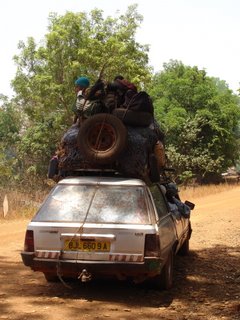
This 25 year old car is carrying 14 people. It was designed for 8. There are three on the front seat, four in the middle, three in the back and three on the roof. I just survived 48 hours in one of these. That's two days and two nights. If we slept, it was beside the road for an hour or so. At one point, in the middle of the night on the 250km mountain bush road between Labe and Koundara with the headlights already failed and ten breakdowns behind us, the driver got out of the car, laid his jacket on the bonnet and lay down to sleep.

"Naomi, he's not fixing the car anymore, what's wrong?" I screamed at my friend who was mad enough to think with me that a trip to the mountains of northern Guinea was a good idea.

Naomi asked our driver what was going on. "Il arrive" he said and sure enough, another over-filled car came chugging along and the driver, someone who had become my only hope in this whole sorry exercise, climbed on its roof and went off, into the moonlit distance. The great American PR machine (Naomi) said, "it's a lovely full moon".

The whole 250 km took us 17 hours. But there is a silver lining to all of this. During break-down number 2, conveniently executed outside a 'restaurant' in a village whose sole income is generated by avocados, I bought 5 of the shiny green fruits for 20 pence. When the car was fixed (temporarily, apparently), I went to put my avocados in the boot of the car. The other passengers had bought sacks of 20 or 30, as well as kilos of mangoes.

"That's nothing" said the driver, a young man with rotten front teeth but a nice smile (amazingly). "Go and buy some more" and he peeled off 2,000 francs and gave them to me.

"He's joking, right?" said Naomi, and I gave the money back to him. He looked confused and went off to buy them for me himself. It was up there in the top 5 romantic gestures ever, and from a man whose name I never found out.

Oh Avacado Man, where were you when we broke down on our next journey, 7 hours from Dakar, when the driver didn't even know that to get an African car started it has to be pushed? And that, by the way, is one of the good things about overloading a car. When it does need to get started again, there is ample supply of young men to get it going.


**********


When people say to you in Senegal something about mountains, they mean something of about 200 metres high. So the hill by my house which I can walk up in ten minutes is a mountain, because it's the highest point in the whole country.

Or so we all thought.

Naomi and I were hanging out one night in her flat in Dakar, and she said she needed to leave the country to get a new visa for Senegal. I just needed to get a bag on my back and start moving. War to the south, desert to the north, and mali to the east. So we decided on Guinea, to the south east.

Kedougou is a dusty little town near the border with Guinea. Not a whole lot going on, but my god is it hot. On the way there (only one breakdown, by the way) the heat scorched my eye-lids as the wind blew in through the car window. But this is Senegal which I am starting to udnerstand is one of Africa's better developed countries, and there was cold water and restaurants at the other end. We had the best steak and salad I have ever eaten, with avocados in the salad without even having to ask. We slept that night in an oven, but there was electricity so we had a fan.

The next day we asked for the bus to Dindefello. They showed us the bus, it was going to leave at some point, but maybe not until the next day. We sat on it for a while then decided there was a better way of getting to this village, and we set out on the road with our thumbs out.

Like a miracle, a man in a pick-up truck arrived and I pleaded with him for a lift. And so this journey, only frequented by cars once a week on market day, was done from the bed of a pick-up, through the forest, across dry river beds, through small villages where children threw mangoes at us (to eat, not to injure us). At Segu, the last village on the Senegal side, a blind police man put our details into a ledger. It took half an hour, long enough for it to pass through both mine and naomi's heads that this was the last record of our existence here and that should anything happen to us, only this man would know we had been this way. When it came to my turn to be written down in the book, I took the pen and did it myself. He stamped our passports, we went on our way.

At Dindefello it was equally as hot. But there is a waterfall there and we grabbed a kid who took us through the forest to the pool and we swam there and tried not to think about river worms. That night, Ricard, a young (but bald) man invited us to his house where we lay on his bed (!), a wicker platform in the compound, which meant it was cool and it was the first time in a couple of days when I didn't feel I was suffocating. He invited us to stay and the next day we checked out of the campement where we were being ripped off by a grisly man who wanted £1.50 for an omlette and moved into Ricard's garden. When i asked the kids where the toilet was, they looked very confused and offered me a bar of soap. Funny, because tht was to happen to me three times. In Guinea when I asked for a pharmacy, all the men standing around in the shop looked confused and then handed me a bar of soap. Go figure.

At 4am, after a couple of hours's sleep, Muktar arrived, the man who had been issued with the job of carrying our bags and 15 litres of water up 5 mountains and across 40 km of rough terrain. He used to be in the Senegalese army and galantly took our load and set off up the mountain, with naomi and I following behind, wishing there was a damn vehicle, or road, which led to Guinea so that we didn't have to walk.

At 6.30 am we got to the border with Guinea, a tree. Soon after that we met the famous Guinean police, a band of stoned, creepy, corrupt men sitting around on their arses waiting for foreigners to wander along so they could see in what ways they could screw things up for them. "We stamp passports at 8am and not before" said the policeman.

"But you're here and we have to do some kilometres before it gets too hot," we protested.

"8 o'clock" he repeated before going off into a tirade to poor Muktar who was trying to find some boiling water so he coud have his morning coffee.

At 8, another policeman arrived, stoned, and took us into a thatch hut to stamp our passports.

"Vaccination card" he demanded, and then didn't look at them. "And you?" he pointed at Muktar.

"I don't have one, I live in a village a million miles from anywhere, least of all a hospital" was what he didn't say.

"Looks like your guide's going to have to leave you, girls" said Creepy Policeman with a grin on his face. I wondered if Naomi was capable of carrying 15 litres of water. He was looking for a bribe of course, so we called his bluff and said that the guide could go and we would carry on alone. Eventually they let us go and Muktar went on anyway.

We walked 30 kilometres before lunch. We passed a village with some heavily-laden mango trees and asked a man if we could buy some. We had a 200 franc coin, 20 pence. He got a stick and pulled down 20 mangoes. They were added to Muktar's already outlandish load. Up ahead, throughout this walk, loomed an enormous jagged mountain. I was in denial that we would ever have to climb it. Ricard, back in Dindefello, never said anything about the mountain being that big so I figured there was some way around it.

But it was that big. And there were four of them. And another 10 km the other side before we reached the first town in Guinea. We started to climb at 4pm and I just had no energy. I guess the tin of sardines we had for lunch just weren't giving me the nutrients I needed, huh? I really thought I wasn't going to be able to go on. So Naomi started one of her many stories that were to get me through the toughest travel week of my life. the idea of the story was to start in one of the United states and tell me every thing she knew about it. "I knew a guy whose cousin came from Ohio..." and up the mountain we went.

After every hike there was a flat-ish plateau where a village had sprung up. From these plateaus we watched the sun setting, ate mangoes, were greeted by people living in round thatch huts, picking manioc leaves, crushing maize, looking after their cows. Along the route we met another man who climbed with us, giving Muktar some moral support with the two girls who were obviously having a hard time of it. We didn't need the PR machine to say encouraging things about the view. I never knew west Africa had such incredible mountains, green stretching all around, and it was the thing that kept me going. Imagine what the town of Mali-ville would be life if it was set in these gorgeous mountains...

**********


After 18 hours of walking we arrived in Mali-ville. It was dark, and Naomi and I were very near tears. There's one hotel in town. it's up a hill, of course. The whole f-ing town is either up or down a hill. We got to the hotel and there was no one there. We shouted for someone to open up, Moktar sat with his head in his hands, I wondered how this day could get worse.

The boy who had been showing us the way started to ask for money. "It's getting better all the time" sang Naomi.

We went back to town and wandered along deserted roads. We climbed another hill and a young guy appeared on a motorbike.

"I'm going to ask him for a room to sleep in" I said, and approached, determined to have him invite us to sleep in his house, wherever that was. But it turned out his father had a 'hotel', a house that was almost finished which he could rent one of the rooms of. He took us there and I told them they could now leave us. Four men stood in the room asking us if we would like to go sight-seeing the next day. I told them to get out of the room because I was going to collapse.

"OK, but would you like us to come tomorrow morning at 7 so you can go sight-seeing. there's a wonderful...".

I went into the bathroom, sat down on the edge of the bath and cried. So I was the first to break. Naomi handled them galantly, got them out, and we collapsed on the bed.

But the bed was not all it seemed.

The matress, a lovely European matress with springs, was still in its plastic cover. The following day, after a noisy night of rustling plastic every time one of us moved, we asked Daoda, the owner's son, if we could take off the plastic cover.

"No, it's to protect against the dust" he said.

"But there is no dust here, it's bare rock everywhere".

There was no budging him. He said if we found the pastic wrapping too hot we could cover it with the thick nylon blanket they had supplied us with.

Next we tried to find food. This is a town of a few thousand people, but not a restaurant in sight. We went out each night with our sights set on something, not too high, just something a bit clean, maybe some salad, maybe a table to sit at, maybe a candle or two.

Each night we were sorely disappointed. We would wak and walk and then end up eating with the ladies who sell grilled meat cooked over a fire on the corner of the street. Sometime we bought an avocado and put it in the sandwich too. Each night I went home wondering which one of us would get sick. But neither of us did. Infact, it was about the only thing that didn't go wrong.

One night we did find a cafe that sold coffee and hot chocolate. We descended upon it as if we had discovered the Ritz on our own street. I ordered cafe au lait and sat down at the rickety wooden bench that looked out on the main street (which a bull promptly sauntered down). the drink came with Naomi's hot chocolate, but it was in fact hot chocolate too. I pointed out this fact, desperate to have some coffee, and the guy looked confused, took it away, and brought back the same cup with some Nescafe sprinkled on top.

"You got mocha!" said the PR machine.

Thursday, April 27, 2006

Au Village


I don’t much feel like writing today. I have a headache from staring at my computer all day long, I am tired from being inside my house all day too, yet feel I should be able to last longer than a few hours at my desk. Somehow I get tired here, I don’t know what it is, maybe not having someone to spur me on, maybe it was my hepatitis jab.

I have been out in the village for two days this week, a couple of hundred kms from Dakar, doing a story on a religious group who have started a commune and a clothing business. Their stuff is made from hand-woven cotton in colourful patchwork and stripes. They make hammocks, clothes, wall hangings, bags, shoes. Their things are sold all over Europe and the USA and are well-designed and well-made. I have been buying their clothes for years; all the toubabs in Dakar buy their stuff because despite this country being full of artists and crafts people, very few people have cottoned on to the fact that for art to be interesting it needs to be unique, or at least not a direct copy of someone else’s copy. The products from Maam Samba have hit the mark and the shop is often stampeded by NGO and UN wives in the four wheel drives after the lastest striped baby booties. It is like the Northcote Road, just hotter.

I have been meaning to go to the village for the last year and finally got a BBC and Reuters commission so decided it was time to go. I arrived at the nearest town, Bambay, at nine o’clock on Monday morning. I was immediately hit by the sound of a young boy’s voice singing a religious song to the people inside the car, begging for money. The voice shot right through me. It was perfectly in tune, not like the warblings of most of these boys who are usually under 10 years old, and vibrating perfectly so that it kind of melted through my body. But I lost sight of him in the confusion of finding another taxi to take me to the village, 11 km through the bush, off the main road.

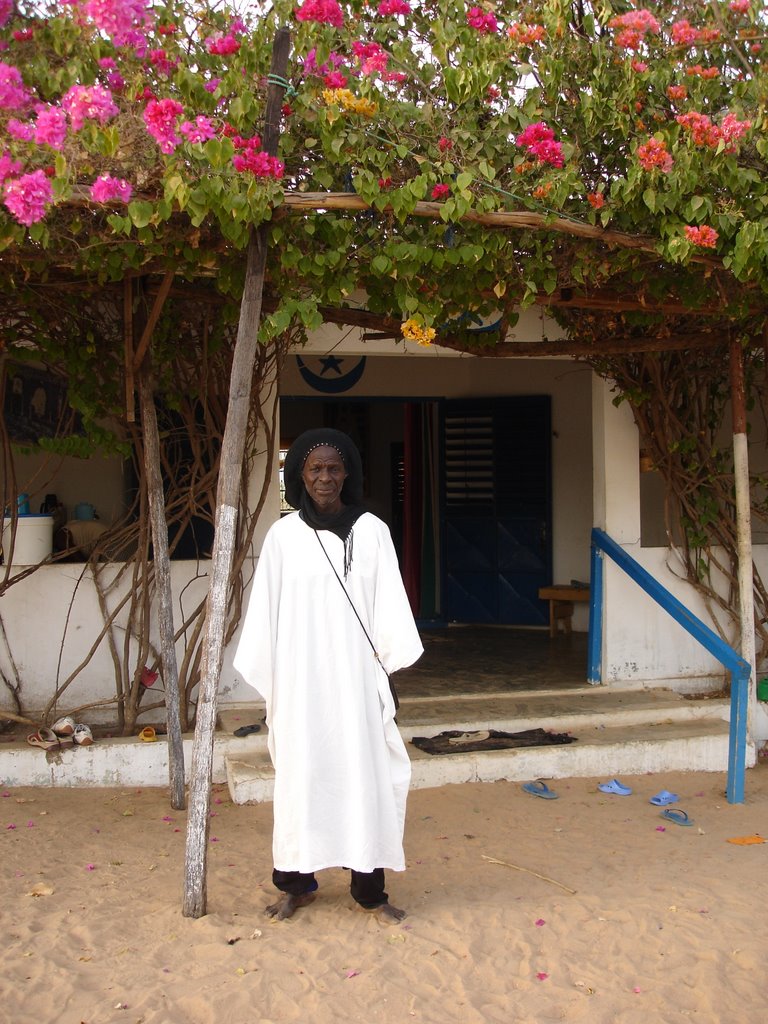
The countryside there is sand and baobab trees and the odd horse and cart rattling through the landscape (see photo of girls collecting firewood for an idea of what it looks like). I arrived at the village, essentially a religious commune, a bright, clean place with rubbish bins (unheard of in Senegal) dotted around, horses tethered under the trees, plants and cactus, bright flowering bougainvillea. The leader of this group is Serigne Babacar (see picture of the man in white a robe), a sixty-something spiritual guide who received a sign whilst in the Pyrenees and returned to the village of his father with his wife, Aisa (a French woman-turned religious devotee).

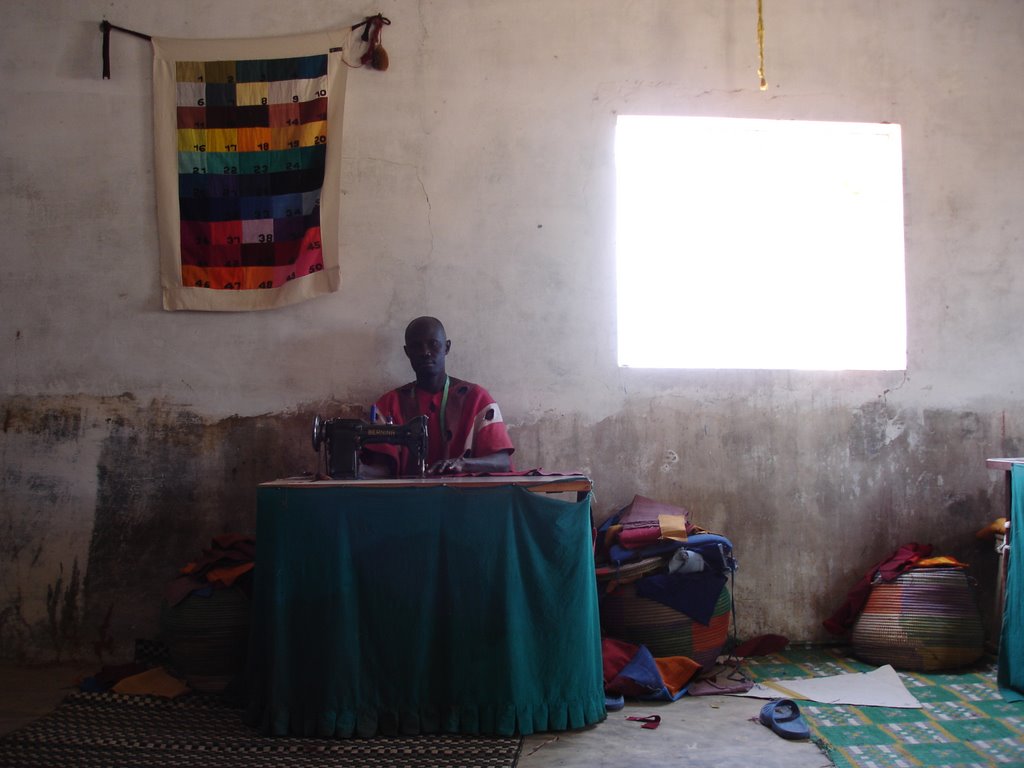
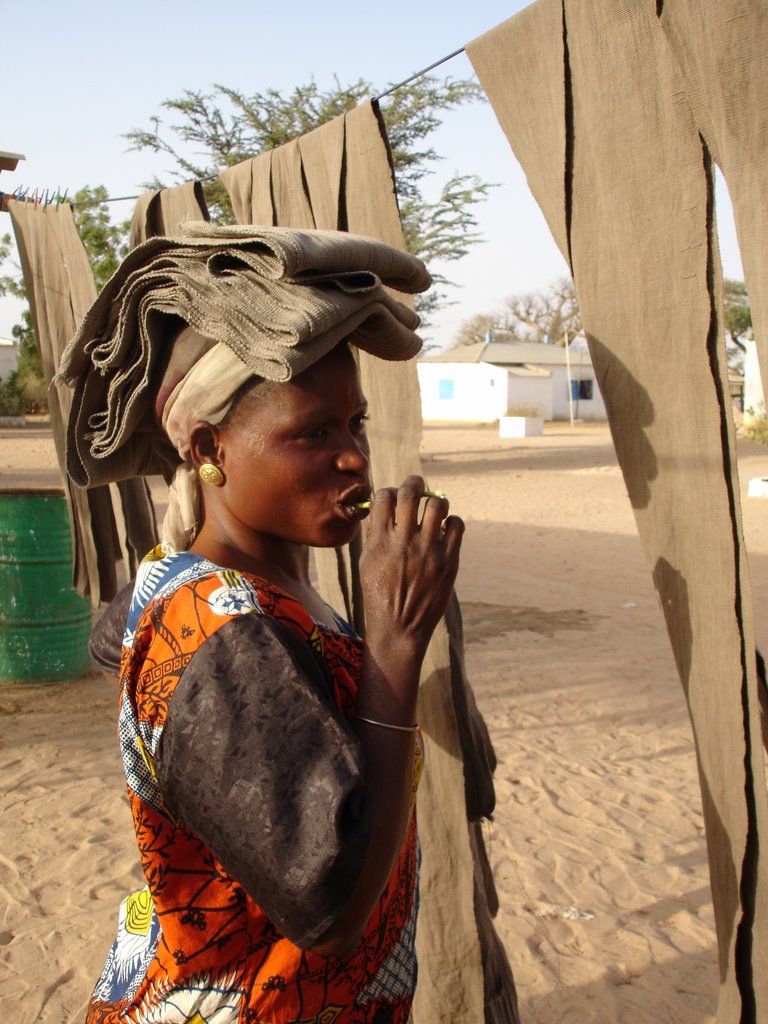
Over twenty years they have built up their commune, and a flourishing clothing business. The cotton is hand-woven by 120 weavers around the 15 villages on long looms, making 100 metres at a time. It is then died either by natural mud dies or chemical dies by local women (see photo of Khady collecting the died cloth on her head), tailored by a team of tailors (see photo), then sent out to its various outlets. The company employs 360 people from the 15 villages around the commune and most of them have only recently come back. Before there was the clothing business the men were forced to go to Dakar to look for work, leaving only children and old people behind. There were no schools, no hospitals, and mostly no water.

Now there are two French schools, one Arabic school, a hospital (see photo of the doctor's daughter Fatim infront of the hospital), a maternity clinic, two deep wells with enough water to grow organic vegetables and cotton and over 300 children going to school. The leader, Serigne Babacar, went from village to village trying to convince the men to let their children do to school. Many of them refused but slowly they have come round to the idea that a French education may not be such a bad thing.

I was deeply impressed by this place. They gave me a room to stay in for two days, food and water and looked after me and let me go around interviewing people without telling me who I should speak to. I found the 5am chanting to the spiritual guide a bit hard to deal with, as well as the PR man telling me to lose 10kg (he later said 2 would be fine), but apart from that it was an amazing experience. The work they have done there is more than anything I have seen either the government or any NGO do in this country. Religion really can be a driving force for development, so it seems.

Part of the success of this business is that this particular sect follows Cheikh Ibra Fall, who was the right hand man of Senegal’s holiest guide Cheikh Amadou Bamba. Ibra Fall’s philosophy was that instead of praying and fasting, one should work hard in the service of those who are praying. “We have time to do all the things that those who pray don’t have time to do,” said one man in the commune. He had been hit by a car in Dakar 17 years ago and come to this village for healing. He is still in a wheelchair but earns a living, and leads a dignified life, by making jewellery.

One of the things that was most noticable about the people at Ndem was that no one called me toubab the whole time I was there. No one tried to make special friends with me, no one looked at me and though "VISA". They were all leading a very normal, but dignified, life, with a job to go to in the morning, on time, and money at the end of it. After seeing how people struggle in the rest of Senegal, how demotivated life without work is, how time has no concept because there's not much to be on time for, it was wonderful to be there.

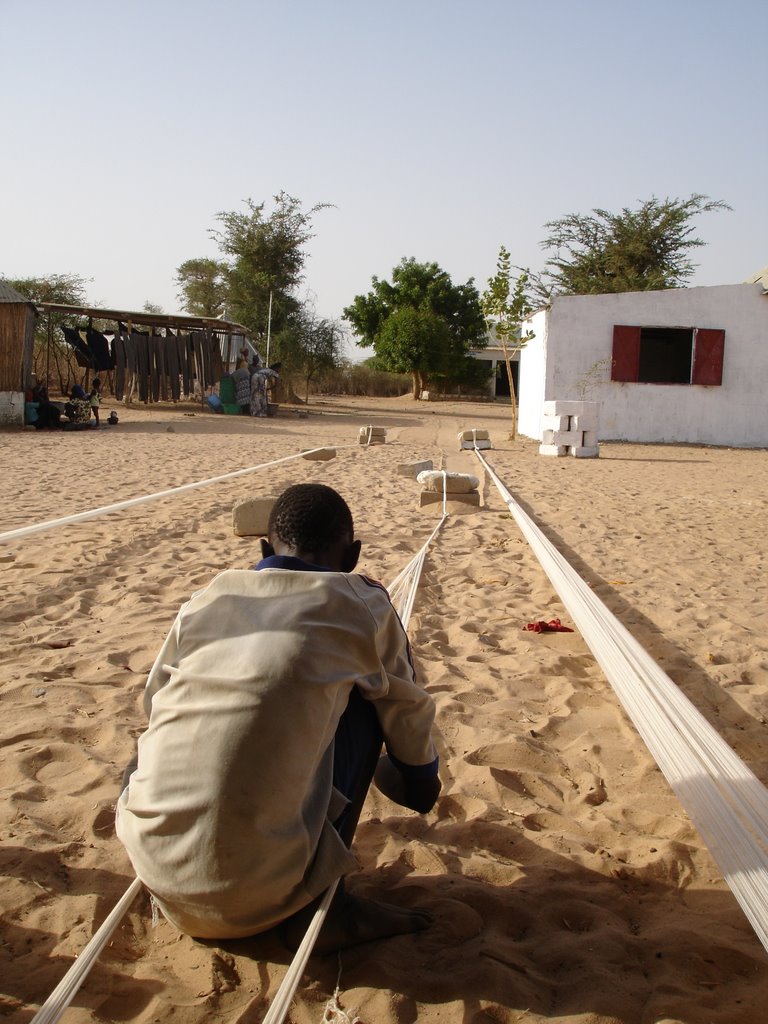
The man who runs the 120 weavers was a very normal, illiterate but highly skilled, man of about 50. When I asked him how different his life was now that he could stay home and teach his sons how to weave plus earn a good living, his face beamed like the sun. What a difference Senegal would be if people had reliable jobs doing the things they are good at, rather than the useless things that help no one, like standing in the middle isle of a motorway for 10 hours a day selling a cheap Chinese iron that breaks after 3 uses. the phot of the boy crouching on the floor with metres of white cotton stretched out infront of him is this man's 14 year old son.

When I left the village on Wednesday, I made it back to the town where I sat in a dakar-bound car and waited for it to fill up. Across the garage came the voice of the young boy I had heard the first morning and I managed to record him singing. He’ll be going out, along with my report, on the airwaves next week.

Saturday, April 22, 2006

'Wass'


'Wass' means 'to gut fish'.

I don't much like fish but I eat it because that is what we eat here. Sometimes you buy it from the fisherman and it is still breathing. When you get it from the market it is at least dead, but still very fish-like. Because of a run-in with the fish-gutting cartel back in March I have decided to gut my own fish and not hand over money to the fat woman who keeps a stock of young girls back behind the market stalls, taking far too much money and not doing any of the work herself.

So today I came back from market with 12 fish, some little ones and 4 big ones. They were very beautiful, pink-ish in colour with a bright purple fin (is that the word?) on the spine (do fish have spine?). But they had to be gutted so Badji, the hero of the neighbourhood (who not only removed frogs from my house when I first moved in but recently put out an electrical fire in the house next door to mine) said, "go and get a stool, a bowl of water and two knives. Here starts your 'wass' education".

So we perched on the ground behind Now's shop and he showed me how to pull out the little fins and the one under its chin, then get my hand inside its gills, pull out that gristly thing (this was the worst bit), then slit its stomach and pull out the guts. Dudu, Kine, Now, Samba,Binta and Ishmaela all gathered round to watch the education of this white girl who can't even gut fish and I closed my eyes and got my fingers in and did the deed.

Then the flies came. Big and fat and vibrating, they landed heavy on the fish and me and the guts and Badji didn't seem to even notice they were there but they made me feel sick and I wished I had a little girl there who would bring a branch and swat them for me. After 12 fish I felt positively sick and had to go home and drink tea and listen to The Archers Omnibus (thank god the soap box derby's over).

But it means I am now initiated, I am now a functional woman in this society, and I can now prepare my own fish. It will be a while before I am able to do it with my eyes open though.

Badji and Ishmaela, my guardian, came to help me cook dinner. Badji, it turns out is a whizz at cooking. I brougt in the rice to pick out the stones and he said he would do it. Ishmaela said that rice was the job of a woman and he shouldn't touch it. But Badji is a good Casamance boy and proud of being able to treat rice in the right way so he sat and picked out the grit (this is what he is doing in the picture, Badji is the one on the left). I cut the onions and made a tomato and onion sauce, as well as fried some butternet squash. The fish was lovely, very sweet and light. We were 8 of us for dinner, all around a bowl outside Now's shop, some of us balancing on gas bottles, some on little benches, the bowl on the sandy ground. As people came to the shop to buy bread for dinner, we took it in turns to serve since Now was eating. This is what constitutes a dinner party in Senegal, and the best place ot be on a Saturday night with no plans.

Friday, April 21, 2006

Ok, Ok...

OK, Linda is my mum.

I had the feeling she got kind of sick being called 'mama' everywhere she went in Senegal, and I had to keep on reminding people that she may be a mama but she is also a Linda, whose youngest offspring now lives far away on a different continent.

Was this really the thing that stood out most from my entry, that I didn't call my mother 'mum'? What about the fact that I had to climb a tree to pick up mobile phone messages (or did I forget to put that in?).

Wednesday, April 19, 2006

The Royal Visit


Leaving behind the inane world of French couples on holiday, Linda and I hired a boat and got as many miles between Cap Skirring and ourselves as possible. Our boat driver was called Paul, he came from a village about half way along the Casamance River system so on our way to Carabane, we dropped in to his village to say hello. We met a painter who designed t-shirts in a thatch hut (see photo) in this village that has water only in the rainy season and no young people. During the dry season (now), the young people leave the island to go to Ziguinchor or Dakar to work. A dry, barren village on the banks of a tributary of the Casamance River, no road, no young people, just the odd old lady cracking nuts with a machete under a tree and another one boiling oysters that grow on the mangrove roots that line the river banks. Despite that, and apart from Linda and I deciding that of all the places in the world we could live, this would be the last, it had a pretty spectacular view down-river. Some of the t-shirts had a condom design on the front as an advery for safe sex. I wish I had bought one. A mad old rasta with a pretty god message.

Between this village and Carabane, Paul picked up a beautiful young woman and her tiny daughter who were paddling their dug-out to another village. We stopped to give them a lift, attaching a rope to her boat and speeding along with them laughing and chatting behind. We dropped them off and quickly picked up some old mamas who were waiting with their goods to sell by the side of the river. They might have been there for days. We took them to Elinkine, a largish village opposite the island of Carabane.

I first went to Carabane Island with Hermione two years ago. We had a perfect four days on this road-less, car-less sandy island, sleeping in a room metres from the water's edge. We lay in hammocks and listened to music at night and swam a great deal. It was one of those trips where I thought if I ever went back, it wouldn 't be as wonderful as it had been the first time. I approached it up the river with apprehension. What if the owners of the house we had stayed in were no longer there, or didn't remember me? I couldn't even remember their names.

Paul, Linda and I saw the house perched on a tip of land at the far end of the island and slowly moved the boat around a sand bar until we could go no further. I saw two figures watching us draw near and as I waded ashore there were smiles and hugs from Medoun and Louis, the two men who live and work in Carabane's eco-guesthouse.

The bedrooms are now even closer to the water. The island is fast being swallowed up by the rising sea level and when you lie in the old rope hammocks that swing between the wind-swept trees that shade the round house, high-tide will wash beneath you. Medoun estimates that in five years time his house will be under water.

During my last visit with Hermione, I had been pre-occupied by work. This time I had nothing to do and so I went about with Medoun as he worked about the house and garden. About a mile away is the well and in the morning we carried 20 litre containers across the mud-flats to fill them up. Near the well is the organic garden, a paradise in this fresh water-starved, salt-water encroached land. Coconuts, avocados, lettuces, hibiscus (for drinks), courgettes, parsley, bamboo (for roofing), all organic, all lovingly watered every day by Medoun and Louis. We picked Cashew fruits (look at the pic!) which grow wild around the garden, filled our water containers, looped the ropes around our waists and dragged the water back along the mud-flats. The rope cut my skin and my shoulders ached from drawing water from the well. it was hot, sweaty, hard work and I loved it all. When we got back to the house we dived into the sea and I instigated under-water swimming races.

Racing against men who do physical work all day long and live their lives by the sea is not a good idea if you want to win. I could swim half the distance they could. We discovered that I am buoyant: my head goes under the water but the rest of me floats to the surface.

After that Louis and I went fishing. Well, I watched and squirmed as the fish were left to suffocate on the sand. He took a circular net strung together by some weights and ropes, held the centre in this teeth, crept into the shallows like a cat on the prowl where he could see a school of fish and flung the net out, releasing the ropes from his teeth at the same time. The net tightened like a purse around the fish and there was dinner, plus food for his family and Medoun's.

It was Medoun's dream ever since he was at school to live in an environmentally-sound house. He is the first Senegalese person I have ever met who even has any awareness of the pressures we put on the earth. Senegal is the land of the plastic bag, but Casamance, with its endless tributaries and mangroves and sleepy languid waters, as well as its bright clear coast and beaches, feels so far away from the rubbish tips of Dakar. Pretty much wherever I am in Casamance I wake up in the morning and feel something akin to magic around me. Medoun has carved out a magical place within that, a solar-powered living-off-the-land haven on the banks of the river that is probably right now my favourite place on earth.

One afternoon Medoun came back from the village with a small boy called Abdoul Rahim. He was about four years old and had seen Medoun in the village and asked if he could come to spend the day with us. he had never been this far across the island and it was a real adventure for him. We played in the hammocks and when it came to going home, I carried him on my back the two miles along the beach to the village. He was so sad to go home. I like how Africans borrow children and it never occurs to their parents that something bad might happen to them, even in Dakar. There is an amazing trust in other people because everybody knows that no one would hurt a child.

So the Royal Visit over, I think I showed her a good time. Linda seems to get what I am doing which means a lot to me. We had power cuts every day in Dakar and she made out it was a real adventure and didn't complain about anything, ever. It's the only way to get by in Africa, not to be bothered by things, something I could learn more of.

Sunday, March 05, 2006

27


So today is my birthday. I've got over my whole thing of being 27 and wondering why I'm doing what I'm doing. I'm doing what I'm doing becsue it's what I'm good at, and because it's what I always wanted to be doing-living in Africa, speaking different and fun languages (I learnt the Wolof for 'puncture' yesterday, 'bain-bain'), being paid (eventually) to meet people and tell stories.

Last night I had some friends over for dinner- Naomi, a freelancer, Steven, a Congolese friend who's still at school but somehow is grown up for a 19 year old, Ann, my neighbour and friend, Dan, a Reuters journalist, and then Chi and myself. I cooked fish on the fire and we drank wine and ate brownies and ice cream and I realised that for the first time since I have lived in Senegal, I was hanging out with people that I had actually chosen to be with, rather than people I was thrown together with because we speak English, or we're journalists, or just because we're foreign. It was a really good feeling.

We sat around my teak table, which suddenly seemed to make sense with people around it, and talked about A-Ha (who we saw in concert this week), bird flu and other stuff that wasn't related to work or involved me desperately trying to find find things I have in common with people, or me trying to prove myself. So much of the last year, I realise, was spent trying to be strong in the face of established journalists and seemingly sorted people, wishing I had people I could talk to, friends to be 'me' infront of instead of being 'Rose New in Dakar Looking for Work'.

At midnight we all piled into Dan's car and drove to town in search of KoolGraoul ('Grow-oul', meaning 'Cool' in Wolof) a monthly club night held in a scuba diving club. All we knew about it was that it was somewhere by the sea but since Dakar is surrounded by sea except for a narrow neck that attaches it to the mainland, there were a lot of possibilities. Eventually, after driving through some diplomatic area where men in balaklavas stood guard outside huge gates and poor Steven screamed from the back seat 'c'est interdit' because we hadn't seen the signs, we were stopped by the police. 'There are too many people in your car' he said gleefully, his green beret sitting lopsided on his head. dan got out of the car and showed the policeman his driving license-and his wallet (which had £1 in it)-and Steven got out to help. After ten minutes of arm-waving, Steven came back to ask for 2,000 francs, £2. The policeman had obviously seen Dan's empty wallet and decided we were a bunch of students and not worth really ripping off. Then he gave us directions to the party. Why Dan had come out with no money I have no idea.

The club was a beautiful terrace covered with overhanging trees and with a good mix of people- toubabs and Africans. We danced to salsa, mbalax, reggae, ska, hip-hop (no Akon thank god), funk, and my favourite, Congolese soukous. With the overhanging branches it was warm and leafy, and with good music, cold Gazelle beer, good friends, it all felt very fitting for a birthday party.

Friday, March 03, 2006

Why you should never be a freelancer or a taxi driver

I will turn 27 on Sunday. It feels somehow dangerously close to 30. I've been asking myself all sorts of things, like why am I still struggling to make my income meet my outgoings, and will my job be this hard when I am 30?

At the moment I feel consumed by the fact that it is Friday and that I have earnt nothing solid since this time last week, but spent a lot of money (not) doing so. This is because I spent Monday and Tuesday being robbed of my mobile phone and trying to recouperate the number, and writing an article that I have since realised needs to be re-written, and Wednesday onwards working on a radio piece that, due to a series of 'mis-understandings' has taken up the rest of the week. It just seems unfair that I'm not paid by the hour, but by the finished product. So if someone is incompetent somewhere and I have to do extra work, I lose out.

And when accounting departments lose bits of paper, I don't get paid (although they do). So really I haven't had any money coming in for two months- it's all numbers on an Excel spreadsheet called 'incoming'. Numbers do not get very far in Dakar taxis.

It feels like a long hard slog, and to what end? I met a man in Casablanca airport recently and he asked me what my five year plan was. I thought I was organised, but I realised that I don't have one, and wonder if I should. My plan for the last three years has been to survive as a writer. In July this year, I will have been a freelance writer for three years. I feel then that I have to decide whether it's going to be make or break. Do I carry on and hope it gets easier, that stories come to me more easily, that my writing needs less re-writing, that my edits are quicker, that my editors stop cocking up and causing me more work, that accounting departments start doing the jobs they are paid for? Or do I call it quits?

My Senegalese neighbour, a 26 year old woman, keeps on asking me what I'm waiting for. She's talking about babies of course. She can't understand why anything could be more important than making a family. I hope we're not still having that same conversation when I am 30, and that I'm not still sitting at my computer on a Friday night at 9.30pm worrying about what some editor in the US thinks about my latest scoop.

There are some wonderful things about my job. Last week I went to interview a musician about whom I knew nothing. Even after researching him, I still had nothing to ask him. So I asked my taxi driver. He gave me five brilliant questions, like, 'why don't you ever sing songs for taxi drivers?' This, as it turned out, was the most pertinant question of them all. Apparently, this musician is planning a song about taxi drivers, because, in his opinion, taxi drivers are one of the most imoprtant but least valued members of society. I wonder if he will write one about journalists? Although, journalists don't take women in labour who have no money to the hospital for free.