Thursday, June 22, 2006

Almost Famous


Following in my pledge to write about life even when it’s crappy, here I am in Toulouse, in a tiny hotel room with a giant extractor fan outside my window spewing fatty smells into the groggy air, miles from the city centre, having had no sleep for 2 nights running. Yes, folks, music journalism is expensive, tiring, and incredibly stressful. It is not the professional holiday-making you might imagine.

I did chose to come to Toulouse and it wasn’t to make money, but I hoped not to lose any. There’s a five-day festival of Senegalese music going on in the beautiful park on the river-side and friends from all-over are here; musician friends from Senegal, Sweden, London, France. It’s a good chance for us all to get together and dance and have fun. But feeling that I can’t take holidays, especially not ones that start with a £350 plane ticket, I scrounged, begged and blagged my way into a few articles and radio pieces which, if I take buses not taxis and eat half-plates of food with Senegalese friends (who will never sit by and watch a girl go hungry) will keep me here until Monday.

So as my Senegalese friends- musicians who have everything paid for for two days so they can strum a few guitar strings for an hour or so- stay in £200 a night hotels in town, get driven around in taxis by drivers whose sole job it is to make sure they get from room to free meal and back to room again safely, and can eat and drink as much as they like for the entirety of their luxurious stay, I, the rich toubab, am going hungry. Where did this all go wrong? They all think it’s funny and share everything around so actually I get driven around too and eat and drink as I please, but I have to do it so the Frogs at the festival don’t see and tell on me…(there’s already been one unsightly altercation over some pasta salad).

Anyway, I got off the plane in Toulouse after an all-night-no-sleep flight via Casablanca and got to my hotel where I got in an hour’s sleep before making a mad dash to and from the phone box and room trying to telephone the PR lady who’s meant to be organising my interview with Senegal’s 75- year old drum revolutionary Doudou N’Diaye Rose. After she had told me twice that she was too busy to deal with me, and that because I was a freelance I couldn’t have a press pass, I gave up and decided I was much more likely to get my interview if I just found the guy’s hotel and asked him myself.

(On the press-pass issue, what makes someone think that because I bring myself here with my own money so that I can do my poorly-paid work to try and cover my costs, means I’m a free-loader? Any old fool can get sent by the BBC on an all-expenses paid trip (and readers, you should know that they do stay in the best hotels, and they do take taxis everywhere unnecessarily, and they do eat and drink in the best restaurants, and that is your TV licensing money that pays for it) and say uninsightful things about Africans and rhythm. All I’m asking for is a 20 Euro pass so that I can do my job properly.)

Anyway, Doudou and I did find each other (in the end, I have to say, the PR lady did come up with the goods) and we did the interview in his porta-cabin and all was going well and then my mini-disc started emitting strange noises…

…sort of crunching noises and whirring and then the monitor showed no peep-peep-peep life signals and I realised that the little innocuous hole where I plug in my microphone has somehow got damaged and no sound is going in. So there goes my £230 job…

After leaping about for an hour or so, (meanwhile the concert is going on and I’m missing all the drumming), trying to get the mini-disc to work and having to run from the stage, where I was recording, to miles away behind the loos where it was quiet enough to listen to the recording to see if it was OK, I did get it to work. Pheww. Got my £230 back.

Then I remembered I had forgotten to take what’s known as a wildtrack, two minutes of sound from the recording room which we use to lay underneath interviews to hid any cuts that get made. So back to the Portacabin where I find a handful of Senegalese drummers all sitting about chatting. The drumming from the stage is too noisy to take my wild track so I have to wait, during which time the Senegalese decide they must make it their mission to find out if I am married, and on discovering I am not, what flight I am taking back so the one who is most ‘in love’ with me (45-ish, quite fat, not too many teeth remaining) can come to the airport to wait for me and give me some children. Nice, thanks. OK, drumming over, Wildtrack can begin, but, oh, wait, my mini-disc isn’t working again, jiggle it around, think I get it, but then someone’s turned on an air-conditioning machine that wasn’t there before, where’s the button, oh fuck, the musicians, twenty of them, are back from stage, and shouting. Fuck!

Next, photos. I can earn myself £22 a photo if I get good ones, and the magazine says they need 3, although some might be printed in black and white in which case I only get £15 a photo, but worth doing anyway. Trouble is, the light’s not good, but, oh, there’s Doudou N’Diaye, “Doudou, can you sit down so I can take a photo, maybe bring your son over to stand next to you, great, thanks”. Snap. Turn around, oh, there’s Doudou N’Diaye behind me. Hang on…shit, that guy's your son? These men all look about the same age but span about 4 generations of the same family. I’m embarrassed and I’ve ended up with photos of the guy’s son by mistake. Anyway, no time to dwell on it, I’ve got to do a stand-up now for Canadian radio, which is where I go to a place and record from there and then narrate off the cuff something witty and insightful and well-spoken. Trouble is, the drumming is too loud (so it’s back behind the loos again) and it’s 8pm and I haven’t yet eaten today, or slept actually, so my hands are shaking and my voice isn’t too good either.

My friend Samba brings me red wine. Then he gets me food (this is where the altercation over the pasta salad comes in but he manages to charm them all with his winning smile and they conceded to let me be nourished that day), and I feel better. Actually, now I’m quite drunk and there’s no light left at all and all I feel I have in my pocket is 2 tapes of fuzzy drumming noise, air-conditioning-unit sound and a bunch of old men asking if they can give me babies.

Still, no time to dwell, I’ve got to get home and get this stuff onto my computer so that tomorrow morning early I can come back and send it all off to Canada and England. Except, the internet place at the festival set up for journalists isn’t going to be open until tomorrow night which means I will miss my deadline, and I can’t do it now because my computer cable’s at the hotel, and…oh fuck it, I send them an email saying I can’t deliver tomorrow morning because I’m exhausted, frazzled, and quite honestly can’t be bothered to work my way out of this one. That’s another £50 down the drain. Never mind, just get home and get some sleep. “Can I have a taxi please?”

“Fully booked madam. It’s the concert, you see…”

Tuesday, June 20, 2006

A place to remember them


How to write about someone you have loved all your life and who suddenly isn’t there anymore? And how to write about two people who had such a great impact on your life, and neither of them are here anymore? How to reconcile my suspicions about what happens after life with my desperate need to believe that something wonderful happens to us?

Twice now I have had the good fortune to have been called from Africa, by some unspoken feeling, to London where I found that a grandparent was dying. The first time I was crossing Mauritania and Morocco by land when I had the irresistible urge to keep going until London. When I got there, my grandpa Ken went into hospital, and died a few weeks later.

Just recently I went for my parents’ birthdays and while I was there, my granny Wendy, four months after losing her husband, followed him. It doesn’t sound enough to say that I loved them; those words are nothing compared to the excitement I would feel when I went to stay with them, or went to the cinema with them followed by smoked salmon and scrambled eggs in their flat. Or the great happiness I got from writing to them and knowing a letter would come from each of them, about the same things seen differently, two weeks later. I’m not sure I’ve even begun to process the fact that they’re not here anymore because it doesn’t seem possible, or right, that they’ll no longer be in my life.

Getting back to Dakar and finding a phone bill and nothing else in my post-box was a sad day. No familiar envelope with my name neatly-written, no saving it up until I was at home with a cup of coffee to really enjoy the two sides of concise prose on what films they had seen, who was doing what in the cricket, the state of the garden at their house in France, plus a reflection on the news I had given them, sometimes funny, sometimes politically-incorrect, but always supportive.

They seemed to find my news interesting, yet their lives were always packed with just as many adventures and stories. They were people I would be happy to hang out with, like I would friends my own age. Granny was always far better dressed than I, and always looked beautiful. Her hair was wonderfully thick and curly and she always wore beautiful jewellery. I used to look at her and think how lucky I was to have her as mine, my own Granny. Other people don’t have grannies like that, grannies are old and crotchety. Not mine, she was just incredibly sharp-witted and fun.

The last thing my grandpa said to me before I went off to Senegal, and it was the last thing he said to me before he got ill, was that whatever anybody said to me about my choice of life and job, he was incredibly proud of me and supported everything I was doing. I was leaving their flat at the time, it was October. He rolled up the sleeves of my jumper, and straightened my collar lovingly. “Yes, we love you” called granny from the kitchen. It is my lasting memory of those two happy people.

I wanted to write something about why these people were so special to me, but I’m not sure I’ve got very far. I feel so incredibly sad when I think about them because I miss them so much. I feel like there is all this stuff inside of me, represented by tears maybe, that needs to come out and not being there for my grandmother’s funeral has made it much harder to face the fact that she has gone. Everybody needs a place to remember the people they love and that place needs to be near. I live in Africa and I don’t have that place, and it has left a horrible hole in my heart.

Saturday, May 13, 2006

Avocado Dreams


This 25 year old car is carrying 14 people. It was designed for 8. There are three on the front seat, four in the middle, three in the back and three on the roof. I just survived 48 hours in one of these. That's two days and two nights. If we slept, it was beside the road for an hour or so. At one point, in the middle of the night on the 250km mountain bush road between Labe and Koundara with the headlights already failed and ten breakdowns behind us, the driver got out of the car, laid his jacket on the bonnet and lay down to sleep.

"Naomi, he's not fixing the car anymore, what's wrong?" I screamed at my friend who was mad enough to think with me that a trip to the mountains of northern Guinea was a good idea.

Naomi asked our driver what was going on. "Il arrive" he said and sure enough, another over-filled car came chugging along and the driver, someone who had become my only hope in this whole sorry exercise, climbed on its roof and went off, into the moonlit distance. The great American PR machine (Naomi) said, "it's a lovely full moon".

The whole 250 km took us 17 hours. But there is a silver lining to all of this. During break-down number 2, conveniently executed outside a 'restaurant' in a village whose sole income is generated by avocados, I bought 5 of the shiny green fruits for 20 pence. When the car was fixed (temporarily, apparently), I went to put my avocados in the boot of the car. The other passengers had bought sacks of 20 or 30, as well as kilos of mangoes.

"That's nothing" said the driver, a young man with rotten front teeth but a nice smile (amazingly). "Go and buy some more" and he peeled off 2,000 francs and gave them to me.

"He's joking, right?" said Naomi, and I gave the money back to him. He looked confused and went off to buy them for me himself. It was up there in the top 5 romantic gestures ever, and from a man whose name I never found out.

Oh Avacado Man, where were you when we broke down on our next journey, 7 hours from Dakar, when the driver didn't even know that to get an African car started it has to be pushed? And that, by the way, is one of the good things about overloading a car. When it does need to get started again, there is ample supply of young men to get it going.


**********


When people say to you in Senegal something about mountains, they mean something of about 200 metres high. So the hill by my house which I can walk up in ten minutes is a mountain, because it's the highest point in the whole country.

Or so we all thought.

Naomi and I were hanging out one night in her flat in Dakar, and she said she needed to leave the country to get a new visa for Senegal. I just needed to get a bag on my back and start moving. War to the south, desert to the north, and mali to the east. So we decided on Guinea, to the south east.

Kedougou is a dusty little town near the border with Guinea. Not a whole lot going on, but my god is it hot. On the way there (only one breakdown, by the way) the heat scorched my eye-lids as the wind blew in through the car window. But this is Senegal which I am starting to udnerstand is one of Africa's better developed countries, and there was cold water and restaurants at the other end. We had the best steak and salad I have ever eaten, with avocados in the salad without even having to ask. We slept that night in an oven, but there was electricity so we had a fan.

The next day we asked for the bus to Dindefello. They showed us the bus, it was going to leave at some point, but maybe not until the next day. We sat on it for a while then decided there was a better way of getting to this village, and we set out on the road with our thumbs out.

Like a miracle, a man in a pick-up truck arrived and I pleaded with him for a lift. And so this journey, only frequented by cars once a week on market day, was done from the bed of a pick-up, through the forest, across dry river beds, through small villages where children threw mangoes at us (to eat, not to injure us). At Segu, the last village on the Senegal side, a blind police man put our details into a ledger. It took half an hour, long enough for it to pass through both mine and naomi's heads that this was the last record of our existence here and that should anything happen to us, only this man would know we had been this way. When it came to my turn to be written down in the book, I took the pen and did it myself. He stamped our passports, we went on our way.

At Dindefello it was equally as hot. But there is a waterfall there and we grabbed a kid who took us through the forest to the pool and we swam there and tried not to think about river worms. That night, Ricard, a young (but bald) man invited us to his house where we lay on his bed (!), a wicker platform in the compound, which meant it was cool and it was the first time in a couple of days when I didn't feel I was suffocating. He invited us to stay and the next day we checked out of the campement where we were being ripped off by a grisly man who wanted £1.50 for an omlette and moved into Ricard's garden. When i asked the kids where the toilet was, they looked very confused and offered me a bar of soap. Funny, because tht was to happen to me three times. In Guinea when I asked for a pharmacy, all the men standing around in the shop looked confused and then handed me a bar of soap. Go figure.

At 4am, after a couple of hours's sleep, Muktar arrived, the man who had been issued with the job of carrying our bags and 15 litres of water up 5 mountains and across 40 km of rough terrain. He used to be in the Senegalese army and galantly took our load and set off up the mountain, with naomi and I following behind, wishing there was a damn vehicle, or road, which led to Guinea so that we didn't have to walk.

At 6.30 am we got to the border with Guinea, a tree. Soon after that we met the famous Guinean police, a band of stoned, creepy, corrupt men sitting around on their arses waiting for foreigners to wander along so they could see in what ways they could screw things up for them. "We stamp passports at 8am and not before" said the policeman.

"But you're here and we have to do some kilometres before it gets too hot," we protested.

"8 o'clock" he repeated before going off into a tirade to poor Muktar who was trying to find some boiling water so he coud have his morning coffee.

At 8, another policeman arrived, stoned, and took us into a thatch hut to stamp our passports.

"Vaccination card" he demanded, and then didn't look at them. "And you?" he pointed at Muktar.

"I don't have one, I live in a village a million miles from anywhere, least of all a hospital" was what he didn't say.

"Looks like your guide's going to have to leave you, girls" said Creepy Policeman with a grin on his face. I wondered if Naomi was capable of carrying 15 litres of water. He was looking for a bribe of course, so we called his bluff and said that the guide could go and we would carry on alone. Eventually they let us go and Muktar went on anyway.

We walked 30 kilometres before lunch. We passed a village with some heavily-laden mango trees and asked a man if we could buy some. We had a 200 franc coin, 20 pence. He got a stick and pulled down 20 mangoes. They were added to Muktar's already outlandish load. Up ahead, throughout this walk, loomed an enormous jagged mountain. I was in denial that we would ever have to climb it. Ricard, back in Dindefello, never said anything about the mountain being that big so I figured there was some way around it.

But it was that big. And there were four of them. And another 10 km the other side before we reached the first town in Guinea. We started to climb at 4pm and I just had no energy. I guess the tin of sardines we had for lunch just weren't giving me the nutrients I needed, huh? I really thought I wasn't going to be able to go on. So Naomi started one of her many stories that were to get me through the toughest travel week of my life. the idea of the story was to start in one of the United states and tell me every thing she knew about it. "I knew a guy whose cousin came from Ohio..." and up the mountain we went.

After every hike there was a flat-ish plateau where a village had sprung up. From these plateaus we watched the sun setting, ate mangoes, were greeted by people living in round thatch huts, picking manioc leaves, crushing maize, looking after their cows. Along the route we met another man who climbed with us, giving Muktar some moral support with the two girls who were obviously having a hard time of it. We didn't need the PR machine to say encouraging things about the view. I never knew west Africa had such incredible mountains, green stretching all around, and it was the thing that kept me going. Imagine what the town of Mali-ville would be life if it was set in these gorgeous mountains...

**********


After 18 hours of walking we arrived in Mali-ville. It was dark, and Naomi and I were very near tears. There's one hotel in town. it's up a hill, of course. The whole f-ing town is either up or down a hill. We got to the hotel and there was no one there. We shouted for someone to open up, Moktar sat with his head in his hands, I wondered how this day could get worse.

The boy who had been showing us the way started to ask for money. "It's getting better all the time" sang Naomi.

We went back to town and wandered along deserted roads. We climbed another hill and a young guy appeared on a motorbike.

"I'm going to ask him for a room to sleep in" I said, and approached, determined to have him invite us to sleep in his house, wherever that was. But it turned out his father had a 'hotel', a house that was almost finished which he could rent one of the rooms of. He took us there and I told them they could now leave us. Four men stood in the room asking us if we would like to go sight-seeing the next day. I told them to get out of the room because I was going to collapse.

"OK, but would you like us to come tomorrow morning at 7 so you can go sight-seeing. there's a wonderful...".

I went into the bathroom, sat down on the edge of the bath and cried. So I was the first to break. Naomi handled them galantly, got them out, and we collapsed on the bed.

But the bed was not all it seemed.

The matress, a lovely European matress with springs, was still in its plastic cover. The following day, after a noisy night of rustling plastic every time one of us moved, we asked Daoda, the owner's son, if we could take off the plastic cover.

"No, it's to protect against the dust" he said.

"But there is no dust here, it's bare rock everywhere".

There was no budging him. He said if we found the pastic wrapping too hot we could cover it with the thick nylon blanket they had supplied us with.

Next we tried to find food. This is a town of a few thousand people, but not a restaurant in sight. We went out each night with our sights set on something, not too high, just something a bit clean, maybe some salad, maybe a table to sit at, maybe a candle or two.

Each night we were sorely disappointed. We would wak and walk and then end up eating with the ladies who sell grilled meat cooked over a fire on the corner of the street. Sometime we bought an avocado and put it in the sandwich too. Each night I went home wondering which one of us would get sick. But neither of us did. Infact, it was about the only thing that didn't go wrong.

One night we did find a cafe that sold coffee and hot chocolate. We descended upon it as if we had discovered the Ritz on our own street. I ordered cafe au lait and sat down at the rickety wooden bench that looked out on the main street (which a bull promptly sauntered down). the drink came with Naomi's hot chocolate, but it was in fact hot chocolate too. I pointed out this fact, desperate to have some coffee, and the guy looked confused, took it away, and brought back the same cup with some Nescafe sprinkled on top.

"You got mocha!" said the PR machine.

Thursday, April 27, 2006

Au Village


I don’t much feel like writing today. I have a headache from staring at my computer all day long, I am tired from being inside my house all day too, yet feel I should be able to last longer than a few hours at my desk. Somehow I get tired here, I don’t know what it is, maybe not having someone to spur me on, maybe it was my hepatitis jab.

I have been out in the village for two days this week, a couple of hundred kms from Dakar, doing a story on a religious group who have started a commune and a clothing business. Their stuff is made from hand-woven cotton in colourful patchwork and stripes. They make hammocks, clothes, wall hangings, bags, shoes. Their things are sold all over Europe and the USA and are well-designed and well-made. I have been buying their clothes for years; all the toubabs in Dakar buy their stuff because despite this country being full of artists and crafts people, very few people have cottoned on to the fact that for art to be interesting it needs to be unique, or at least not a direct copy of someone else’s copy. The products from Maam Samba have hit the mark and the shop is often stampeded by NGO and UN wives in the four wheel drives after the lastest striped baby booties. It is like the Northcote Road, just hotter.

I have been meaning to go to the village for the last year and finally got a BBC and Reuters commission so decided it was time to go. I arrived at the nearest town, Bambay, at nine o’clock on Monday morning. I was immediately hit by the sound of a young boy’s voice singing a religious song to the people inside the car, begging for money. The voice shot right through me. It was perfectly in tune, not like the warblings of most of these boys who are usually under 10 years old, and vibrating perfectly so that it kind of melted through my body. But I lost sight of him in the confusion of finding another taxi to take me to the village, 11 km through the bush, off the main road.

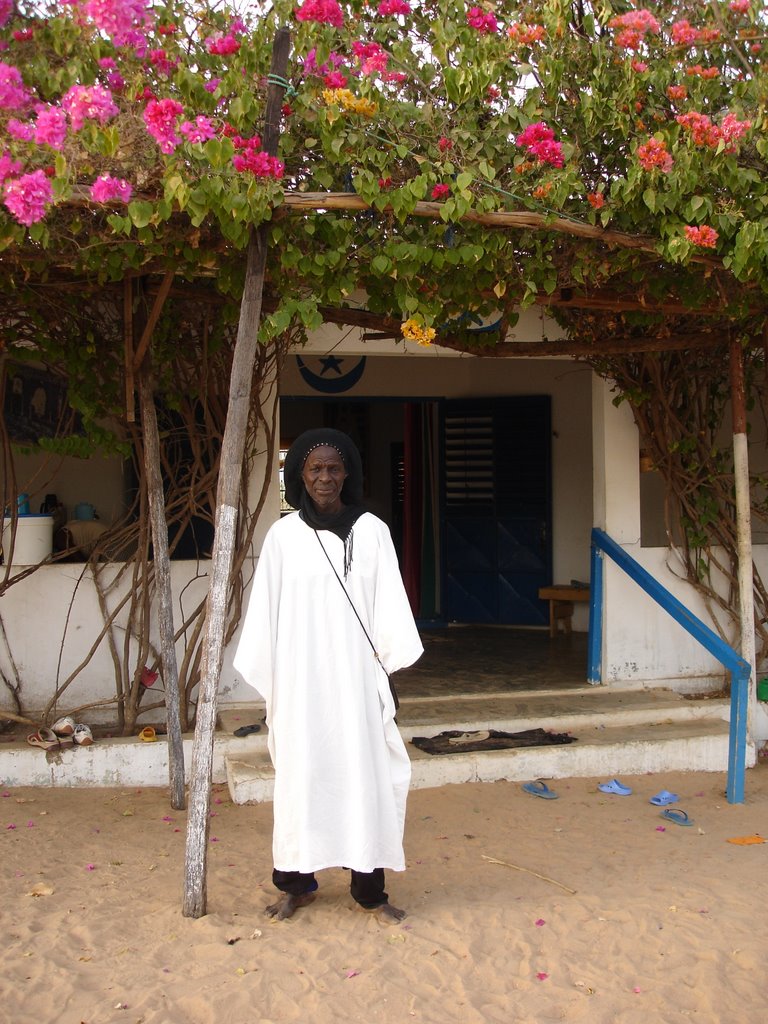
The countryside there is sand and baobab trees and the odd horse and cart rattling through the landscape (see photo of girls collecting firewood for an idea of what it looks like). I arrived at the village, essentially a religious commune, a bright, clean place with rubbish bins (unheard of in Senegal) dotted around, horses tethered under the trees, plants and cactus, bright flowering bougainvillea. The leader of this group is Serigne Babacar (see picture of the man in white a robe), a sixty-something spiritual guide who received a sign whilst in the Pyrenees and returned to the village of his father with his wife, Aisa (a French woman-turned religious devotee).

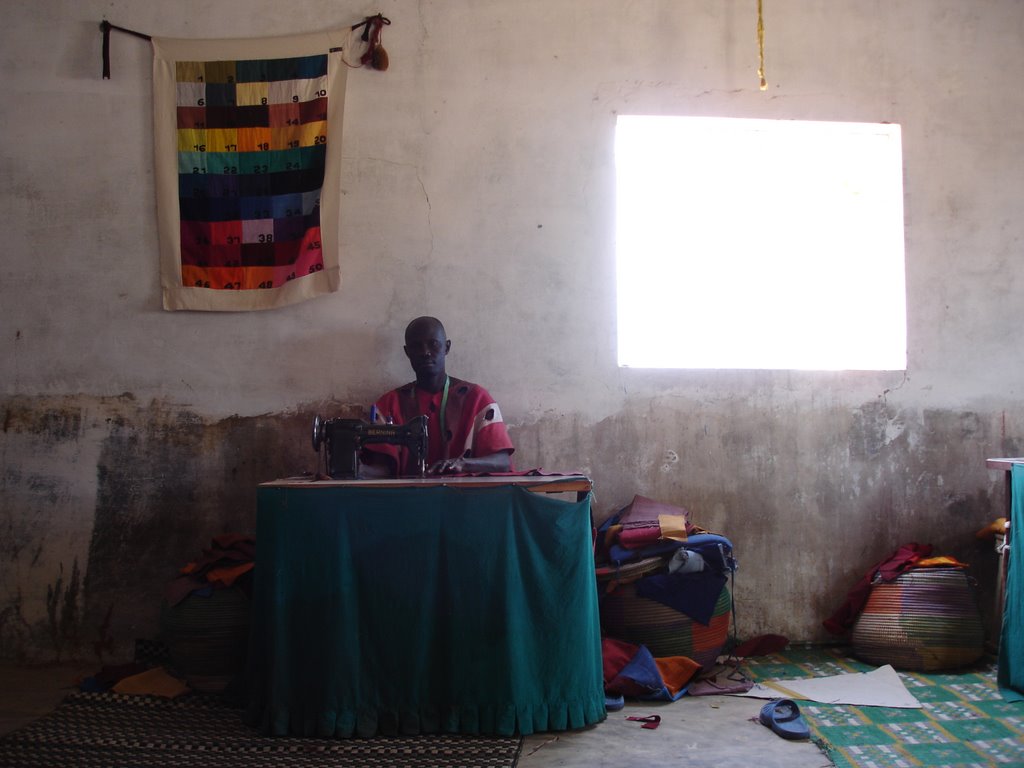
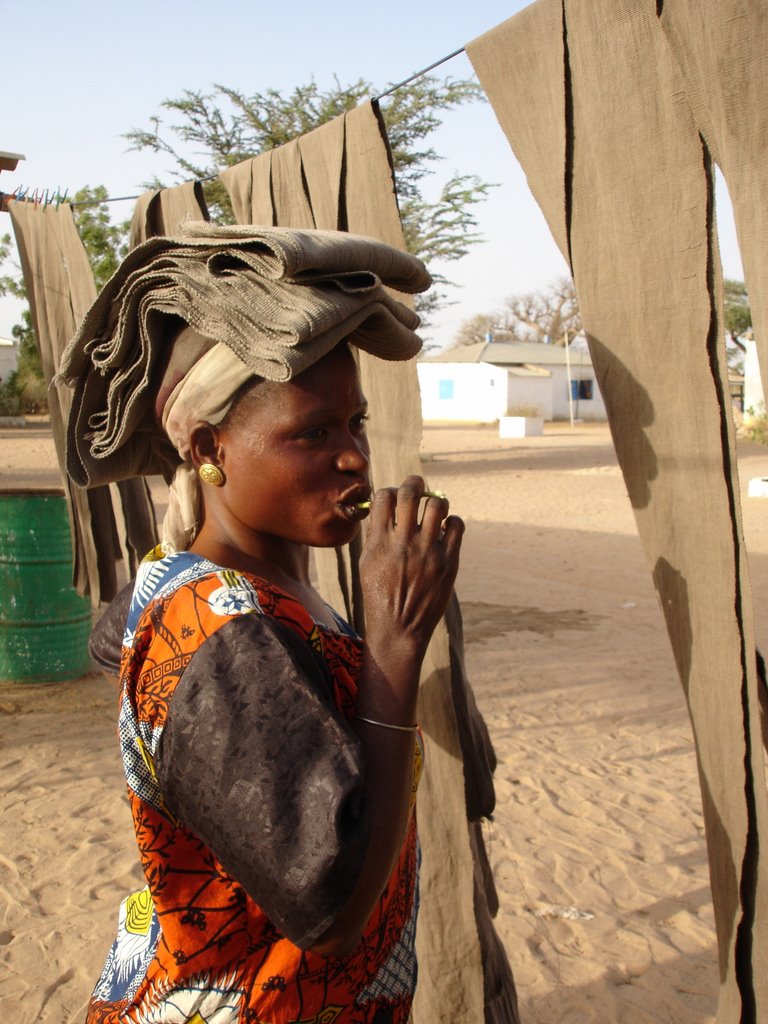
Over twenty years they have built up their commune, and a flourishing clothing business. The cotton is hand-woven by 120 weavers around the 15 villages on long looms, making 100 metres at a time. It is then died either by natural mud dies or chemical dies by local women (see photo of Khady collecting the died cloth on her head), tailored by a team of tailors (see photo), then sent out to its various outlets. The company employs 360 people from the 15 villages around the commune and most of them have only recently come back. Before there was the clothing business the men were forced to go to Dakar to look for work, leaving only children and old people behind. There were no schools, no hospitals, and mostly no water.

Now there are two French schools, one Arabic school, a hospital (see photo of the doctor's daughter Fatim infront of the hospital), a maternity clinic, two deep wells with enough water to grow organic vegetables and cotton and over 300 children going to school. The leader, Serigne Babacar, went from village to village trying to convince the men to let their children do to school. Many of them refused but slowly they have come round to the idea that a French education may not be such a bad thing.

I was deeply impressed by this place. They gave me a room to stay in for two days, food and water and looked after me and let me go around interviewing people without telling me who I should speak to. I found the 5am chanting to the spiritual guide a bit hard to deal with, as well as the PR man telling me to lose 10kg (he later said 2 would be fine), but apart from that it was an amazing experience. The work they have done there is more than anything I have seen either the government or any NGO do in this country. Religion really can be a driving force for development, so it seems.

Part of the success of this business is that this particular sect follows Cheikh Ibra Fall, who was the right hand man of Senegal’s holiest guide Cheikh Amadou Bamba. Ibra Fall’s philosophy was that instead of praying and fasting, one should work hard in the service of those who are praying. “We have time to do all the things that those who pray don’t have time to do,” said one man in the commune. He had been hit by a car in Dakar 17 years ago and come to this village for healing. He is still in a wheelchair but earns a living, and leads a dignified life, by making jewellery.

One of the things that was most noticable about the people at Ndem was that no one called me toubab the whole time I was there. No one tried to make special friends with me, no one looked at me and though "VISA". They were all leading a very normal, but dignified, life, with a job to go to in the morning, on time, and money at the end of it. After seeing how people struggle in the rest of Senegal, how demotivated life without work is, how time has no concept because there's not much to be on time for, it was wonderful to be there.

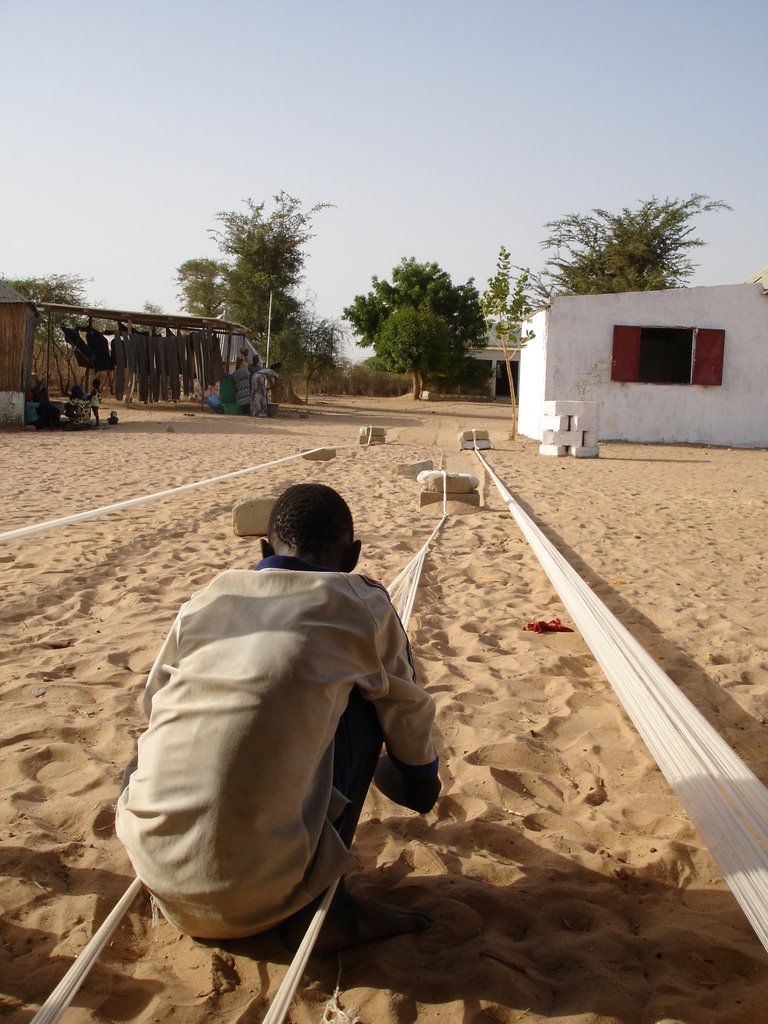
The man who runs the 120 weavers was a very normal, illiterate but highly skilled, man of about 50. When I asked him how different his life was now that he could stay home and teach his sons how to weave plus earn a good living, his face beamed like the sun. What a difference Senegal would be if people had reliable jobs doing the things they are good at, rather than the useless things that help no one, like standing in the middle isle of a motorway for 10 hours a day selling a cheap Chinese iron that breaks after 3 uses. the phot of the boy crouching on the floor with metres of white cotton stretched out infront of him is this man's 14 year old son.

When I left the village on Wednesday, I made it back to the town where I sat in a dakar-bound car and waited for it to fill up. Across the garage came the voice of the young boy I had heard the first morning and I managed to record him singing. He’ll be going out, along with my report, on the airwaves next week.

Saturday, April 22, 2006

'Wass'


'Wass' means 'to gut fish'.

I don't much like fish but I eat it because that is what we eat here. Sometimes you buy it from the fisherman and it is still breathing. When you get it from the market it is at least dead, but still very fish-like. Because of a run-in with the fish-gutting cartel back in March I have decided to gut my own fish and not hand over money to the fat woman who keeps a stock of young girls back behind the market stalls, taking far too much money and not doing any of the work herself.

So today I came back from market with 12 fish, some little ones and 4 big ones. They were very beautiful, pink-ish in colour with a bright purple fin (is that the word?) on the spine (do fish have spine?). But they had to be gutted so Badji, the hero of the neighbourhood (who not only removed frogs from my house when I first moved in but recently put out an electrical fire in the house next door to mine) said, "go and get a stool, a bowl of water and two knives. Here starts your 'wass' education".

So we perched on the ground behind Now's shop and he showed me how to pull out the little fins and the one under its chin, then get my hand inside its gills, pull out that gristly thing (this was the worst bit), then slit its stomach and pull out the guts. Dudu, Kine, Now, Samba,Binta and Ishmaela all gathered round to watch the education of this white girl who can't even gut fish and I closed my eyes and got my fingers in and did the deed.

Then the flies came. Big and fat and vibrating, they landed heavy on the fish and me and the guts and Badji didn't seem to even notice they were there but they made me feel sick and I wished I had a little girl there who would bring a branch and swat them for me. After 12 fish I felt positively sick and had to go home and drink tea and listen to The Archers Omnibus (thank god the soap box derby's over).

But it means I am now initiated, I am now a functional woman in this society, and I can now prepare my own fish. It will be a while before I am able to do it with my eyes open though.

Badji and Ishmaela, my guardian, came to help me cook dinner. Badji, it turns out is a whizz at cooking. I brougt in the rice to pick out the stones and he said he would do it. Ishmaela said that rice was the job of a woman and he shouldn't touch it. But Badji is a good Casamance boy and proud of being able to treat rice in the right way so he sat and picked out the grit (this is what he is doing in the picture, Badji is the one on the left). I cut the onions and made a tomato and onion sauce, as well as fried some butternet squash. The fish was lovely, very sweet and light. We were 8 of us for dinner, all around a bowl outside Now's shop, some of us balancing on gas bottles, some on little benches, the bowl on the sandy ground. As people came to the shop to buy bread for dinner, we took it in turns to serve since Now was eating. This is what constitutes a dinner party in Senegal, and the best place ot be on a Saturday night with no plans.

Friday, April 21, 2006

Ok, Ok...

OK, Linda is my mum.

I had the feeling she got kind of sick being called 'mama' everywhere she went in Senegal, and I had to keep on reminding people that she may be a mama but she is also a Linda, whose youngest offspring now lives far away on a different continent.

Was this really the thing that stood out most from my entry, that I didn't call my mother 'mum'? What about the fact that I had to climb a tree to pick up mobile phone messages (or did I forget to put that in?).

Wednesday, April 19, 2006

The Royal Visit


Leaving behind the inane world of French couples on holiday, Linda and I hired a boat and got as many miles between Cap Skirring and ourselves as possible. Our boat driver was called Paul, he came from a village about half way along the Casamance River system so on our way to Carabane, we dropped in to his village to say hello. We met a painter who designed t-shirts in a thatch hut (see photo) in this village that has water only in the rainy season and no young people. During the dry season (now), the young people leave the island to go to Ziguinchor or Dakar to work. A dry, barren village on the banks of a tributary of the Casamance River, no road, no young people, just the odd old lady cracking nuts with a machete under a tree and another one boiling oysters that grow on the mangrove roots that line the river banks. Despite that, and apart from Linda and I deciding that of all the places in the world we could live, this would be the last, it had a pretty spectacular view down-river. Some of the t-shirts had a condom design on the front as an advery for safe sex. I wish I had bought one. A mad old rasta with a pretty god message.

Between this village and Carabane, Paul picked up a beautiful young woman and her tiny daughter who were paddling their dug-out to another village. We stopped to give them a lift, attaching a rope to her boat and speeding along with them laughing and chatting behind. We dropped them off and quickly picked up some old mamas who were waiting with their goods to sell by the side of the river. They might have been there for days. We took them to Elinkine, a largish village opposite the island of Carabane.

I first went to Carabane Island with Hermione two years ago. We had a perfect four days on this road-less, car-less sandy island, sleeping in a room metres from the water's edge. We lay in hammocks and listened to music at night and swam a great deal. It was one of those trips where I thought if I ever went back, it wouldn 't be as wonderful as it had been the first time. I approached it up the river with apprehension. What if the owners of the house we had stayed in were no longer there, or didn't remember me? I couldn't even remember their names.

Paul, Linda and I saw the house perched on a tip of land at the far end of the island and slowly moved the boat around a sand bar until we could go no further. I saw two figures watching us draw near and as I waded ashore there were smiles and hugs from Medoun and Louis, the two men who live and work in Carabane's eco-guesthouse.

The bedrooms are now even closer to the water. The island is fast being swallowed up by the rising sea level and when you lie in the old rope hammocks that swing between the wind-swept trees that shade the round house, high-tide will wash beneath you. Medoun estimates that in five years time his house will be under water.

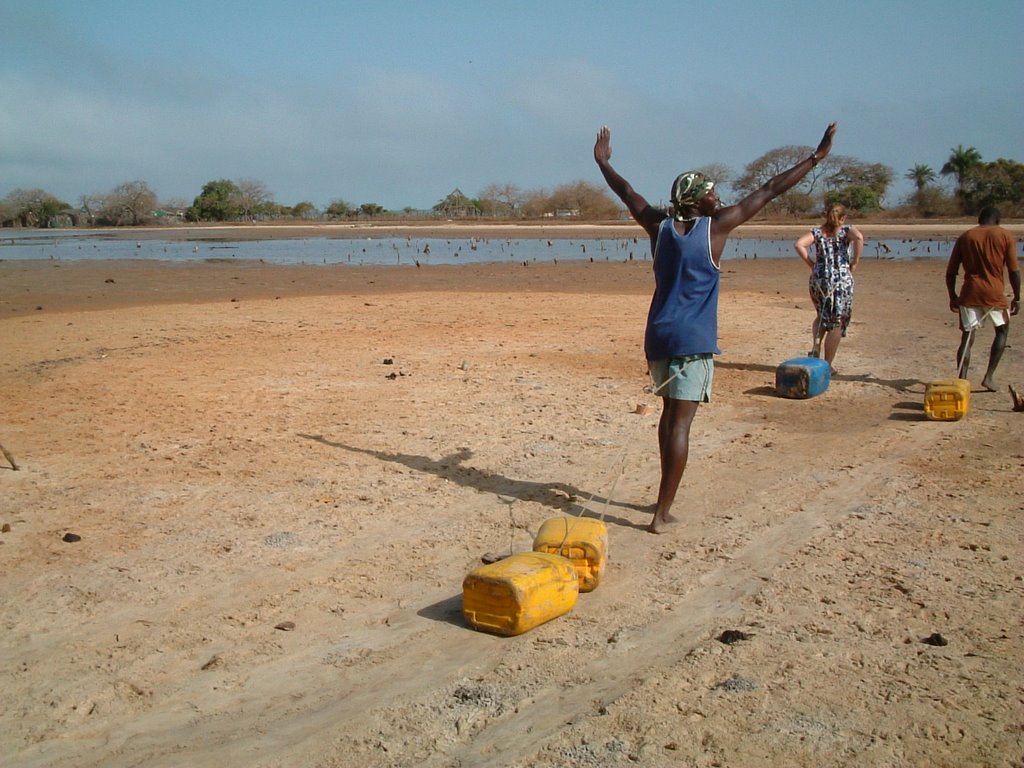
During my last visit with Hermione, I had been pre-occupied by work. This time I had nothing to do and so I went about with Medoun as he worked about the house and garden. About a mile away is the well and in the morning we carried 20 litre containers across the mud-flats to fill them up. Near the well is the organic garden, a paradise in this fresh water-starved, salt-water encroached land. Coconuts, avocados, lettuces, hibiscus (for drinks), courgettes, parsley, bamboo (for roofing), all organic, all lovingly watered every day by Medoun and Louis. We picked Cashew fruits (look at the pic!) which grow wild around the garden, filled our water containers, looped the ropes around our waists and dragged the water back along the mud-flats. The rope cut my skin and my shoulders ached from drawing water from the well. it was hot, sweaty, hard work and I loved it all. When we got back to the house we dived into the sea and I instigated under-water swimming races.

Racing against men who do physical work all day long and live their lives by the sea is not a good idea if you want to win. I could swim half the distance they could. We discovered that I am buoyant: my head goes under the water but the rest of me floats to the surface.

After that Louis and I went fishing. Well, I watched and squirmed as the fish were left to suffocate on the sand. He took a circular net strung together by some weights and ropes, held the centre in this teeth, crept into the shallows like a cat on the prowl where he could see a school of fish and flung the net out, releasing the ropes from his teeth at the same time. The net tightened like a purse around the fish and there was dinner, plus food for his family and Medoun's.

It was Medoun's dream ever since he was at school to live in an environmentally-sound house. He is the first Senegalese person I have ever met who even has any awareness of the pressures we put on the earth. Senegal is the land of the plastic bag, but Casamance, with its endless tributaries and mangroves and sleepy languid waters, as well as its bright clear coast and beaches, feels so far away from the rubbish tips of Dakar. Pretty much wherever I am in Casamance I wake up in the morning and feel something akin to magic around me. Medoun has carved out a magical place within that, a solar-powered living-off-the-land haven on the banks of the river that is probably right now my favourite place on earth.

One afternoon Medoun came back from the village with a small boy called Abdoul Rahim. He was about four years old and had seen Medoun in the village and asked if he could come to spend the day with us. he had never been this far across the island and it was a real adventure for him. We played in the hammocks and when it came to going home, I carried him on my back the two miles along the beach to the village. He was so sad to go home. I like how Africans borrow children and it never occurs to their parents that something bad might happen to them, even in Dakar. There is an amazing trust in other people because everybody knows that no one would hurt a child.

So the Royal Visit over, I think I showed her a good time. Linda seems to get what I am doing which means a lot to me. We had power cuts every day in Dakar and she made out it was a real adventure and didn't complain about anything, ever. It's the only way to get by in Africa, not to be bothered by things, something I could learn more of.

Sunday, March 05, 2006

27


So today is my birthday. I've got over my whole thing of being 27 and wondering why I'm doing what I'm doing. I'm doing what I'm doing becsue it's what I'm good at, and because it's what I always wanted to be doing-living in Africa, speaking different and fun languages (I learnt the Wolof for 'puncture' yesterday, 'bain-bain'), being paid (eventually) to meet people and tell stories.

Last night I had some friends over for dinner- Naomi, a freelancer, Steven, a Congolese friend who's still at school but somehow is grown up for a 19 year old, Ann, my neighbour and friend, Dan, a Reuters journalist, and then Chi and myself. I cooked fish on the fire and we drank wine and ate brownies and ice cream and I realised that for the first time since I have lived in Senegal, I was hanging out with people that I had actually chosen to be with, rather than people I was thrown together with because we speak English, or we're journalists, or just because we're foreign. It was a really good feeling.

We sat around my teak table, which suddenly seemed to make sense with people around it, and talked about A-Ha (who we saw in concert this week), bird flu and other stuff that wasn't related to work or involved me desperately trying to find find things I have in common with people, or me trying to prove myself. So much of the last year, I realise, was spent trying to be strong in the face of established journalists and seemingly sorted people, wishing I had people I could talk to, friends to be 'me' infront of instead of being 'Rose New in Dakar Looking for Work'.

At midnight we all piled into Dan's car and drove to town in search of KoolGraoul ('Grow-oul', meaning 'Cool' in Wolof) a monthly club night held in a scuba diving club. All we knew about it was that it was somewhere by the sea but since Dakar is surrounded by sea except for a narrow neck that attaches it to the mainland, there were a lot of possibilities. Eventually, after driving through some diplomatic area where men in balaklavas stood guard outside huge gates and poor Steven screamed from the back seat 'c'est interdit' because we hadn't seen the signs, we were stopped by the police. 'There are too many people in your car' he said gleefully, his green beret sitting lopsided on his head. dan got out of the car and showed the policeman his driving license-and his wallet (which had £1 in it)-and Steven got out to help. After ten minutes of arm-waving, Steven came back to ask for 2,000 francs, £2. The policeman had obviously seen Dan's empty wallet and decided we were a bunch of students and not worth really ripping off. Then he gave us directions to the party. Why Dan had come out with no money I have no idea.

The club was a beautiful terrace covered with overhanging trees and with a good mix of people- toubabs and Africans. We danced to salsa, mbalax, reggae, ska, hip-hop (no Akon thank god), funk, and my favourite, Congolese soukous. With the overhanging branches it was warm and leafy, and with good music, cold Gazelle beer, good friends, it all felt very fitting for a birthday party.

Friday, March 03, 2006

Why you should never be a freelancer or a taxi driver

I will turn 27 on Sunday. It feels somehow dangerously close to 30. I've been asking myself all sorts of things, like why am I still struggling to make my income meet my outgoings, and will my job be this hard when I am 30?

At the moment I feel consumed by the fact that it is Friday and that I have earnt nothing solid since this time last week, but spent a lot of money (not) doing so. This is because I spent Monday and Tuesday being robbed of my mobile phone and trying to recouperate the number, and writing an article that I have since realised needs to be re-written, and Wednesday onwards working on a radio piece that, due to a series of 'mis-understandings' has taken up the rest of the week. It just seems unfair that I'm not paid by the hour, but by the finished product. So if someone is incompetent somewhere and I have to do extra work, I lose out.

And when accounting departments lose bits of paper, I don't get paid (although they do). So really I haven't had any money coming in for two months- it's all numbers on an Excel spreadsheet called 'incoming'. Numbers do not get very far in Dakar taxis.

It feels like a long hard slog, and to what end? I met a man in Casablanca airport recently and he asked me what my five year plan was. I thought I was organised, but I realised that I don't have one, and wonder if I should. My plan for the last three years has been to survive as a writer. In July this year, I will have been a freelance writer for three years. I feel then that I have to decide whether it's going to be make or break. Do I carry on and hope it gets easier, that stories come to me more easily, that my writing needs less re-writing, that my edits are quicker, that my editors stop cocking up and causing me more work, that accounting departments start doing the jobs they are paid for? Or do I call it quits?

My Senegalese neighbour, a 26 year old woman, keeps on asking me what I'm waiting for. She's talking about babies of course. She can't understand why anything could be more important than making a family. I hope we're not still having that same conversation when I am 30, and that I'm not still sitting at my computer on a Friday night at 9.30pm worrying about what some editor in the US thinks about my latest scoop.

There are some wonderful things about my job. Last week I went to interview a musician about whom I knew nothing. Even after researching him, I still had nothing to ask him. So I asked my taxi driver. He gave me five brilliant questions, like, 'why don't you ever sing songs for taxi drivers?' This, as it turned out, was the most pertinant question of them all. Apparently, this musician is planning a song about taxi drivers, because, in his opinion, taxi drivers are one of the most imoprtant but least valued members of society. I wonder if he will write one about journalists? Although, journalists don't take women in labour who have no money to the hospital for free.

Wednesday, February 22, 2006

A better time


I was exceedingly down on life in my last posting. I was really ready to give up on Senegal, and my feelings were more about me than about Senegal.

I have since perked up. A trip to Gambia will always make one feel more happy about one's own life.

We have had no electricity or internet for two days. But I am finding people much easier to get on with, and making new friends. I have eaten out, with people, every night this week, and lunch too.

Yesterday I went to collect my bed. I brought it back on the famous horse and cart that I like so much to travel on. The horse was so skinny that we stopped to buy it a bag of hay. The driver, Abdou, installed the bed at home and now I have a flat-mate, Chi, and a telephone line, and a bed, it all seems too perfect. The weather is lovely, blue skies, dry, warm, and they are filming a Wolof soap opera in my street. Suddenly, everything seems sunny.

Wednesday, January 25, 2006

Dakar by Bus


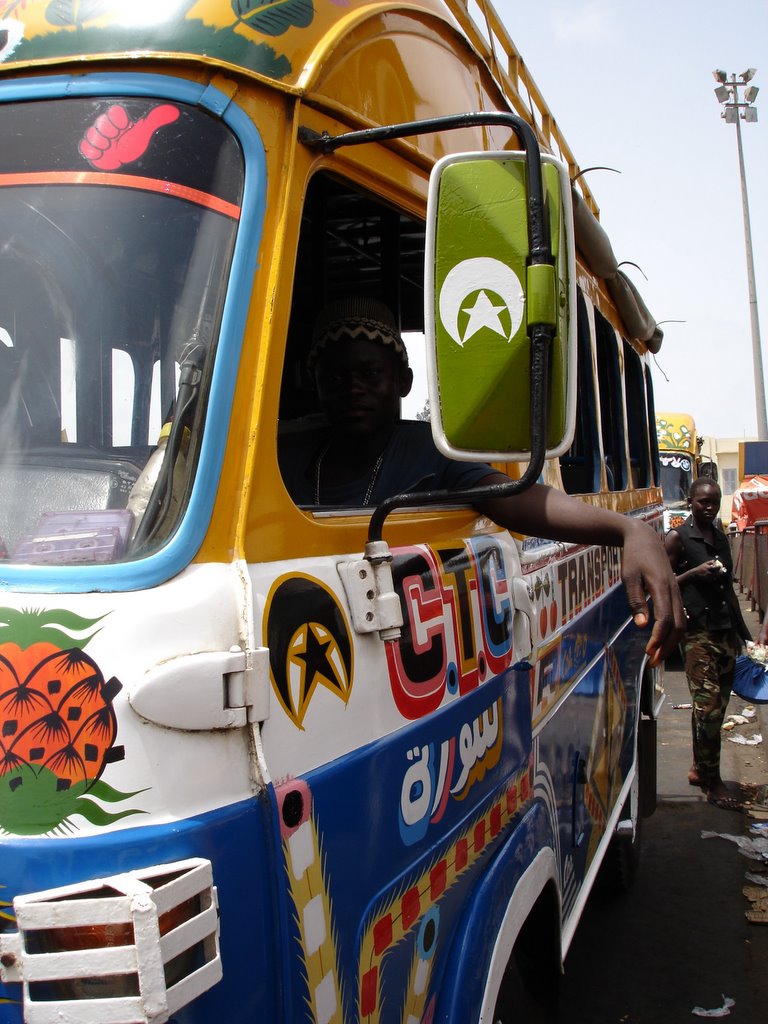
Taking Dakar’s buses, the diagen-djiaye, is an art. They hurtle up and down the Route de Oukham, from town at one end and past the turning to my house at the other. They are run by groups; a driver and two ‘apprentis’, dusty-faced boys who hang off the back shouting their destination “dakadakadakadaka” for town and “wakawakawakawaka” for my end of the route. These boys can look around ten years old and be as mean as anything.

The buses are in bad shape and you can always hear them coming. Their rattling tin structures are held together by people, five to a row, ten rows, two passengers in the front with the driver. The only exits are at the back and at the front, and no alley for passing through the bus. So if you get in, you have to make quite sure that you don’t want to get out very quickly. They do not let you stand and if one person climbs out, everybody has to up and advance “advanadvanadvan” through the bus until the seats are filled again, with more entering the back until the whole bus is full, “fesnafesnafesna”.

When you want to get off, you stand and tap a coin noisily on the roof and shout “maima”, ‘let me off’, until the driver slows down. Sometimes he doesn’t want to stop and then old men and fat women start shouting “maiko”, 'let her down', in a crescendo, sometimes in chorus, sometimes in harmony, until he is forced to pull over. You must always grumble when getting out, either about the time it took for the driver to stop or about the change the apprentis gave you, as the fares are fixed but no one knows what they are and they differ from bus to bus.

The floor of the bus has holes in it to give you the Chessington World of Adventures feeling. There is nothing more fun than to watch pot holes disappear at speed underneath you.

The front of the bus is plastered, usually seeping half way down the windscreen, in photos of religious idols and pop idols. Cheikh Ibra Fall stands in austere dress next to Viviane N’Dour in threads of lycra. He is bony because he lived a life of hard work in devotion to his spiritual guide. She is bony because otherwise she wouldn’t fit into her dress.

At night time the buses are packed more than usual with people going home from work and a bare light bulb lights the inside, swinging to and fro and knocking people’s heads when they stand up.

A fat lady climbs in next to me. She is wearing a pale blue bouboub widely cut across her shoulders so that her bra straps are showing, her shoulders and much of her back. I can almost feel the cushion of her skin and she smells of perfumed water. With her bra straps she is saying ‘I have nursed ten children and will nurse their children too’. She all but smothers me in her folds of flesh and, perching on the middle tip-up seat which accommodates only the smallest of bottoms, I squash up next to my neighbour on the other side and apologise for all but smothering him. He doesn’t seem to mind.

The apprentis starts shouting “passpasspasspass” for us to pass back our fares. Each coin travels ten rows, from hand to hand, the apprentis prodding the fat lady with a dirty finger, and her fleshy fingers poking the bony man infront, and he tapping the girl in a headscarf infront of him and she pointing to the boy two rows infront of her until the passenger has been identitfied, says where he is going, argues with the apprentis about the price, then reluctantly passes back a coin, from hand to podgy hand until it reaches the apprentis who roots around in his pencil case, finds the right change, prods the fat woman and gives her the coin which moves deftly along the rows until it reaches its rightful owner. With one passenger taken care of, so the next must be attended to.

“This is gymnastiques,” says my neighbour, a young man coming home from college. My stop comes and I bang on the roof. The fat woman shouts “mai-ko” and the driver slows down. She starts grumbling and I have to climb over her because she refuses to move. I cut my leg on a shard of metal sticking out from one of the seats.

Just as I start to climb down the wooden boards at the back of the bus, the driver moves off. "Mai-ko" they all shout and the apprentis rings a bell loudly. I grab hold of the ladder which is partly attached to the back and swing down onto the road, which has started moving. The bus behind advances towards me and I am engulfed in fumes from my own bus. This is all part of the diagen-djiaye experience.

Friday, January 13, 2006

Oncl' Sam's


Today is the big festival of the mutton in Senegal and everything is shut. Shops, internet, transport. Everybody is at home slaughtering a sheep and letting its blood run into the earth, to keep the family well for the year ahead. They tell me that my neighbours will come to give me some meat later- at least, this is what happens in the countryside. But my street is new to me and even though the thought of mutton doesn't excite me much, because all the shops are shut I only have crispbread and peanut butter to eat so rather hope it does happen.

My flat is lovely to wake up in. My bedroom faces onto the end of the airfield (and this baobab tree, see photo) where planes don’t come and all I can hear in the mornings is birds perched on the distant baobab trees. Sometimes one comes knocking on my window.

After six months of living either in a compound with lots of people, or in other people’s houses as a kind of guest that never leaves, to live alone is a treat. I listen to the World Service almost all the time, catching those programmes you always seem to miss when there is going out to work to be done, or other people around. I work when I like, sometimes until two am and then go to the beach in the day. I eat chocolate for dinner, if I feel like it, and if I want to I can do quite a good job of forgetting I am in Africa. I think I will last much longer here if I have my own hideaway because in the end, we all hanker after the familiar, after crispbread and peanut butter instead of mutton intestines. But it doesn’t mean I love Africa any less.

Last night I finished work at midnight and I felt like dancing. I called my friend Gabi, a computer engineer and asked if he felt like going out. Taxi prices have shot up because everyone is saving for their sheep and I had long discussions with taxi men as to why I should have to pay more just because they have three wives and twenty children to feed. Gabi lives in a neighbourhood with a lot of Congolese and Ivorian people and there is a place there called ‘Oncl’ Sam’s’, a kind of warehouse filled with plastic furniture, florescent strip lights and hundreds of people grouped around tables groaning under the weight of empty beer bottles.

Gabi and I sat a table with some of his friends and I counted forty-five empty beer bottles on our table before my eyes blurred. There were girls twitching and grinding their bottoms to Congolese songs pumping out of a booth in the corner and men wearing sunglasses slumped low in their chairs, looking like they were going to fall asleep. Every now and then, they would leap up and dance in a row, all watching themselves in the huge mirrors that lined every inch of wall space, doing the most extraordinary dance moves, to great applause from their friends.

One girl in particular caught everyone's attention. She wore a very small pair of jeans and a g-string with a silver bow joining the threads together. She was a hit with the boys. The silver bow flashed and glinted under the harsh lights so that no one could take their eyes off it. Her perfectly round bottom became the focus point of the evening. Everyone was so beautifully turned out and I, as ever, felt like a refugee even though I was wearing a dress. I felt so white under those lights, and so old looking on at the scene of debauchery with wide-eyed shock. I had fun but I hope I never have to go there again, or if I do, I will make sure I wear much less clothing and drink a lot more beer.

I have a neighbour in Dakar who is a bit more up my street. She’s from Birmingham and lives alone, too. We said we would go out and listen to music together. It’s good to have friends.

Every afternoon this week, after I finish work, I have been going to the beach below the cliffs opposite my house. A lighthouse looms above it on the cliffs and the sea is calm, protected by the bay. I take Jane Austen and wield it at the boys like a sword and hope they will leave me alone. In this cold weather the sea is quite soft and peaceful and sometimes it rubs off on me.

Sunday, December 25, 2005

Sahara


It's been quite a month. I was back in Senegal a week before I had the chance to leave again, this time by foot, across the Sahara.

At Rosso, Senegal, I was set upon by bandits who took money to send me across the Senegal River, and the border with Mauritania, to an illegal landing point where I climbed through a whole in a wall to enter Mauritania without a stamp in my passport. Then I had to go back to the border the next morning and explain that I had made a mistake, and would they put a little stamp on that page. They did, for a fee.

In Mauritania, there is only one thing to do. There is a train (see photo), the longest train in the world. It runs from Schoum, a selection of huts in the Sahara, to Nouadibou, a town on the coast and border with Western Sahara. This train is 2.5km long, 200 open wagons, and carries iron ore to the port for export.

I reached Schoum under the guidance of a man in a blue butcher's coat, a hulk of a man with a mass of facial hair. He carried a baby goat in his arms, cradling it as if it wasn't going to be eaten later. He and I took a 4x4 to Schoum across desert of blinding beauty, we stopped for prayer at sunset, to pick up a man living with his family in a tent, to drink some camel milk.

The desert is not empty, as I imagined. It is full of low bushes and camels and hillocks and hills and rocky outcrops and families living in one place before moving to the next. It is cold and windy when the sun lowers, and to fall asleep in the car and to awake looking out of the window at such a lonely and confrontational landscape, as if in its infinite size it has the power to swallow small people up, is humbling. Frightening.

At Schoum, the butcher, the goat, and I stood in the darkness straddling a narrow set of train tracks. We looked both ways and saw no lights. Perhaps the train had already left. We asked some kids, they said the train was late. I went to a gas-lit hut and asked for some couscous, which they brought, with a camel bone in the middle, shards of meat and sprinklings of sand. The friend of the couscous server took me in another 4x4 to the train tracks and we saw a light in the distance, the front of the train, and one kilometers behind it, the rear. It rattled past and eventually stopped. I climbed a ladder into a wagon full of fine iron ore and the man waved me off.

I stayed 18 hours on the wagon, my head wrapped in a cloth to keep out the black powder and the cold. It was a full moon and under it I travelled 700 kilometers across the Sahara, past dunes and camels standing lonely on a hill, past villages built from oil drums, nomad dwellings, through the night and into a cold and misty morning.

At Nouadibou, the taxi driver would not let me sit in the front of the car. This is not a woman's world.

I shared the taxi with a man who looked like a Rajasthani Indian, fine black circles ringing his eyes and a long slender face. The driver was as dark and round-faced as a Senegalese. A woman got in as pale as me, dark brown eyes. They all spoke Arabic. No two Mauritanians look like they come from the same place and both men and women are as striking as any people I know. The men wear billowing pale blue cloths, the women metres of pinks and yellows and reds.

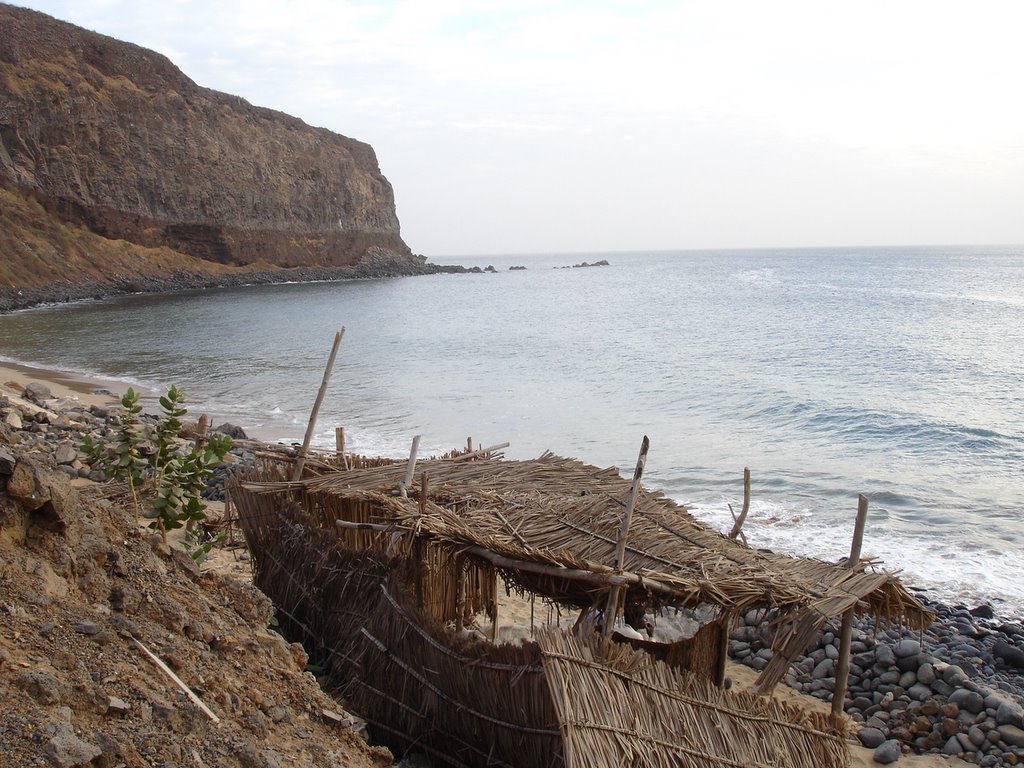
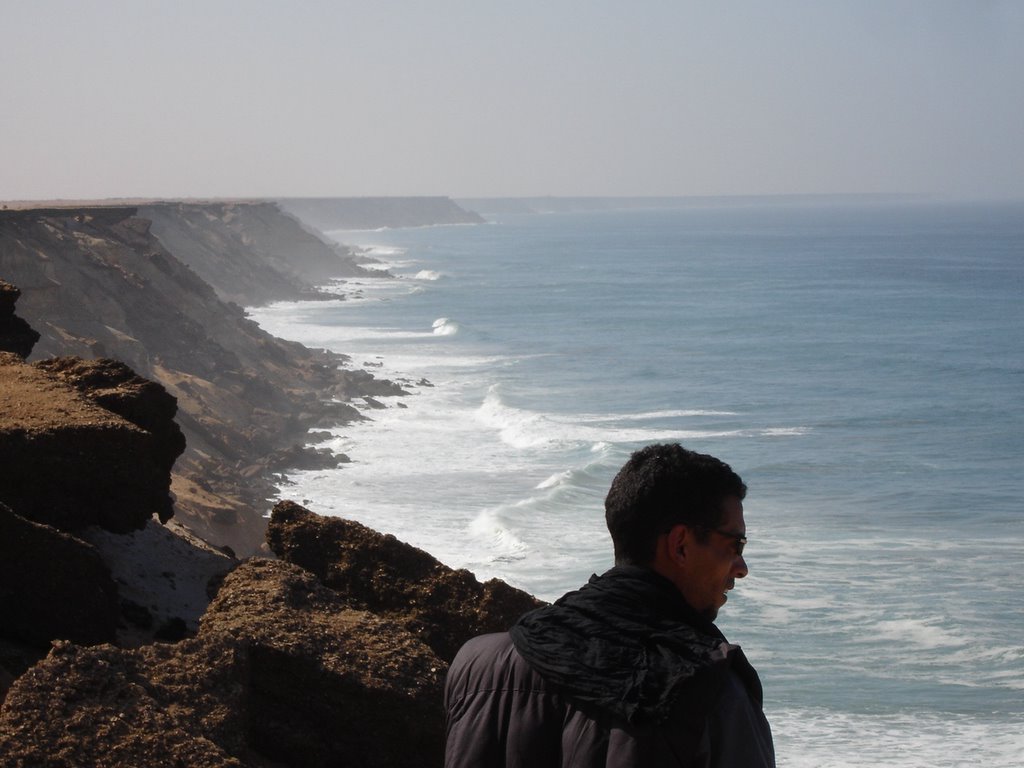
In Western Sahara, I hitch-hiked on a sardine truck, flip-flop vans and in a Mercedes Benz. The driver of the sardine truck, pictured here on the coast of this vast country, played independence-for-Western Sahara-music (suprisingly cheery stuff) for 600km and refused to take any money at the end of the trip. In the flip-flop van I was accompanied by two Mauritanians who sat in the back with the plastic shoes and brewed tea on a gas canister. When it was ready they drummed on the side of the van and we stopped and climbed out into the night, the sand beneath my feet cold like snow, and drank tea in the darkness. The driver was pleased to give me, a woman, a job (handing round the tea). So there is a role for women in this country, after all.

In Rabat, Morocco, I went to the steam baths. After a hot scrub I sat in the changing room and talked to other women. It was the first time I had spoken to a woman, spoken openly to anyone, since leaving Senegal. They asked me what cause I defended as a journalist and I felt this was a country and a people I could love, a people engaged in politics and world events. I told them women in Mauritania can not sit in the front of cars and they were horrified. Here, they said, we are free.

I ate well in Morocco. Fresh vegetables, good bread, stuffed sardines, mint tea, grilled meat, spices and dates and sweet nutty treats. I saw thousand year old arches hiding clusters of blue and white houses, Andalucian gardens filled with clementine trees. Men bringing in olives from the fields, saddle bags straddling donkeys, barefooted children herding goats. Goats climbing trees. Stylish and sophisticated cities, uncluttered, clean. Not one person tried to sell me a carpet. And I wanted to buy one.

In London no one believed I saw goats climbing trees.

Monday, November 28, 2005

Coming Home


On Saturday night Ado and Aliou, friends from the neighbourhood, came to dinner. In the morning I went to my local market, a shed full of ladies at tables, each selling:

Three or four floppy carrots
Quarters of cabbage
MSG ‘stock’ cubes
Handful of dried fish pieces
Unknown green leaf with holes in it
Small sachets of pepper and chilli
Single cloves of garlic
Perfectly round white onions
One aubergine

I have a friend, Kris, who sells fish. Kris is very fat and quite beautiful, loud as you might imagine a fish seller, prone to cackling and trying to sell me off to the meat seller. She sold me some mackerel so I went home with a basket of fish and floppy carrots. With this and some spices I managed to secrete into my luggage from Brixton Wholefoods, I made a good hot curry, which went well with the salted and grilled fish (done by my kitchen aid, Mariam Tounkara) and a bowl of white rice, steamed by Tapha’s sister Rama.

Curry was good but I wished for double cream.

I made all of this with a small child on my back, Kati, who insisted on tasting everything that went into my mouth so that I dropped hot sauce on my shoulder as she tried to get it into her mouth.

Ado and Aliou came to eat, we sat on the mat outside the house, and I wished I’d made Senegalese food. Senegalese people don’t like to be surprised by food and I think the vegetable curry was a bit too much for them to bear. They left the bowl very early on in the proceedings. I was left with the children, who came to suck the fish heads, and we put in another twenty minute’s good work at the bowl before I felt so full I had to go and lie down.

At midnight I donned my new dress and went on the back of my motorbike to le Tamarinier, a bar in town. Tapha’s band were playing there, so I danced with Kris the fish seller and her enormously fat sister and brother until 4am. Kris is trying to win back her ex-boyfriend, zacharia, who plays in the band, so she made elaborate displays of affection during the concert, like rolling up very close to him and dancing, seductively placing bits of fresh coconut in his mouth while he strummed his guitar faster and faster. I’m not sure his motorbike will cope with them getting back together. It was always broken when he used to have to ferry her around town on it.

On Sunday morning, I was invited to lunch by Pap Toutti, the bassist in the band. We all met at Samuel’s house, a French engineer who is working in Ziguinchor on the new port. I went to discuss the band, which has run into recording problems because the man employed to record the album has given up working on it since he received the money. We decided that the band had to get its own speakers, since half the money they earn from concerts goes to hire the equipment. Samuel suggested a concert for his company working at the port, and instead of being paid the cash, Samuel will buy them the speakers with the money.

At three oclock, we decided to have a rehearsal that evening. I called Tapha, who organised going to le Tamarinier to pick up the instruments left there the night before and to hire the speakers for the evening. I sent Pap Tutti off on his bike to find Zacharia, who lives on the other side of town. I sent Matar, Tapha’s brother, on my bike to fetch Maho, the guitarist, and eventually all arrived except Maho, who was playing in another concert at the church. The rehearsal started less than an hour late, a miracle in precision timing, something that doesn’t come naturally to Ziguinchorois.

I was in charge of the children, who all poured in from the neighbourhood and battled for front row seats in the courtyard. There were a lot of tears as boys smacked girls and girls pushed boys off chairs. With Kati tied on my back I did the washing as the music played and made falafel for dinner. I sent Coyo, my kitchen aid, to the market to buy salad and bread, and then went off in search of mayonnaise.

I found a woman who sells mayonnaise by the spoon. One spoon = 50 francs, 5 pence. She was sitting outside her shop roasting peanuts. She only wanted to sell me the stuff if I brought her the bread to spread it on. I told her I wanted it in a little plastic sachet and would even pay her 50francs for the sachet. She couldn’t bring herself to do this; apparently it upset her delicate sense of order and balance to do something a bit out of the ordinary.

There was a lot of discussion. She continued roasting peanuts and Kati, now by my side and holding my hand, started chanting for peanuts. Eventually the woman squeezed herself through a narrow gap in the shop front and went backstage to put my mayonnaise in a bag. I started asking myself how long that pot had been sitting there open, unrefrigerated and what I might possibly catch from it. I decided salmonella was my best bet. She took a long time to measure out my two spoons of mayonnaise and when she came up for air, she was bent on the ground, I said it wasn’t enough. She said that two spoons of mayonnaise in a bag was smaller in quantity than two spoons of mayonnaise on bread.

Discouraged, I took my bag of warm salmonella back to the house where the band were really getting going and a group of women had gathered by the compound door and were dancing wildly. Someone came along to play the tama drum, a small drum that goes under the arm and changes pitch as it’s squeezed. I was set upon by the little girls who all wanted me to carry them so I danced instead. Tapha’s father came along to watch, very small these days, leaning on the front door frame.

This band, if they get themselves organised, will be the most popular band in Senegal one day. iIt's soulful, full of funk, one family of brothers making good sounds.

With rehearsal over, I set about frying the falafel. Falafel, I decided in England, was my best chance of eating enjoyable nutritious food. When I found chick peas in town, it was like all my christmases had come at once.

But the gas I cook on, a bottle with a small gas ring screwed into it, burns the food on one side and doesn’t get hot on the other. Also, the oil I used (Senegalese oil; I am trying to support local enterprise) somehow dissolved my falafel into a kind of chick pea and oil soup. It had to be thrown away.

It was only the first time I have cried from frustration since coming home so things are going quite well. I had rice and fish for dinner.

Tuesday, November 01, 2005

Fridges and donkeys


Well, this is my first ever blog. I hope I'm doing it right.

I started doing this a few months ago when I moved to Senegal but then I never had the right surroundings to actually post anything on it. Now I am back in London for a few weeks recovering and I happened to meet a friend, Barbara, who runs a world music festival in Sweden (www.selam.se) who said when I told her the story about the donkey that if I got my blog going, she'd link it to her website.

So this is for you Barbara.

I'm Rose. I live in a damp shed in Ziguinchor, in the south of Senegal. I built it in 5 days, not with my own bare hands, but Asso, the mason, built it out of concrete (although I wanted mud). I have lived in it for five hot rainy months, and it's never dried out. I have a foam mattress (mouldy), and now a sofa which looks uncomfy but is in fact quite good. I brought the fabric from Guinea Bissau when I went to cover the elections (I'm a journalist).

The house is in a compound of a family. There are 20-something people in this family, maybe more, I'm not sure. Also in the compund is a recording studio with a soundproof booth made from mud and a car windscreen for the window. I'll talk about the studio on another day. I have lots of adopted children, all under 7 years old. They help me cook and come into my house and put sand everywhere. During mango season I made mango jam and it was a disaster. That was back in the early days when I still had energy, before summer came.

So I live in this house, I write articles about music and economy and security situations and I try to live and cool and relaxed African life. It's sometimes not so easy.

Should I explain about the donkey?

After three months or so of living in my damp shed, I decided to buy a fridge. There was a whisper on the streets that someone was selling one on the other side of town, for £50. I went over on my motorbike and had a look. You know those fridges you see abandoned on the street in Brixton that you might put rubber gloves on to touch? i think there's a thing going on where people collect those fridges and send them to Africa. I'm sure it's an African who's doing it. This fridge has cockroaches living in the plastic door seal. I say 'has', I paid the cash and took it home.

People transport things in Ziguinchor by donkey. Salet mbam (wolof for 'donkey cart') are everywhere, a guy with a whip sitting on the cart, transporting things around town. We called a salet mbam from the road, argued over the price for taking the fridge home, then sent him on his way while I made my way slowly back via motorbike.

Now this fridge is in my damp shed. We have an electric cable that runs from the main house in the compound through their bathroom window, through mine, through the bedroom and into the living room. I hang my washing on the cable. It has a rusty fan that dangles off a wire at the back and when the electricity cuts twice a day (or when one of the kids sticks his fingers into the chinese adapter and cuts off the supply) it sighs to a halt and then bursts back to life in the middle of the night, the noise reverberating through the house and waking me up. By that time icy water has melted all over the floor (but never drowning the cockroaches) and the wet floor mats have started to rot.

BUT! We do have cold food and I got to drive a donkey.

This is a photo of me eating mangoes in the compound. And drinking Swiss Miss Hot Chocolate imported from America by my sister, as were the martini glasses and swizzel sticks. There'll be more postings once I'm back in Senegal, and maybe I'll tell the story of how I got fridge number 2 home (never underestimate the efficiency of child labour).

pip pip, Rose